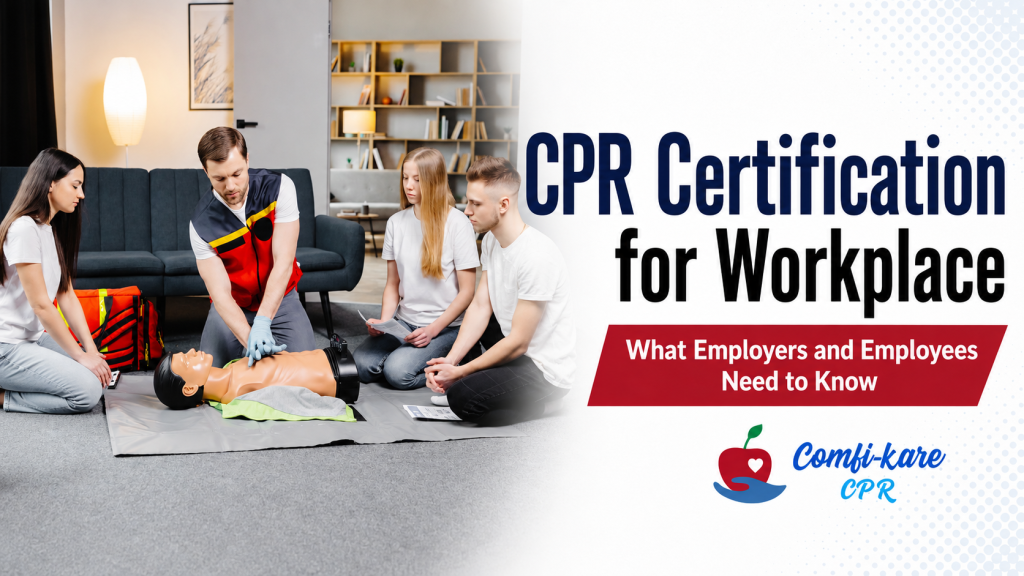
A medical emergency at work can happen without warning.
An employee may collapse at a desk, become unresponsive in a warehouse, experience a medical emergency during a company event, or need immediate help while emergency medical services are still on the way.
That makes CPR certification for workplace teams an important part of emergency preparedness.
But employers often have several questions: Does OSHA require CPR? Which employees should be trained? Is CPR/AED enough, or do workers also need First Aid? And how many people should receive certification?
There is no single answer for every business. Workplace requirements depend on the industry, hazards, access to medical services, applicable regulations, and employer policies.
Does Your Workplace Need CPR-Certified Employees?
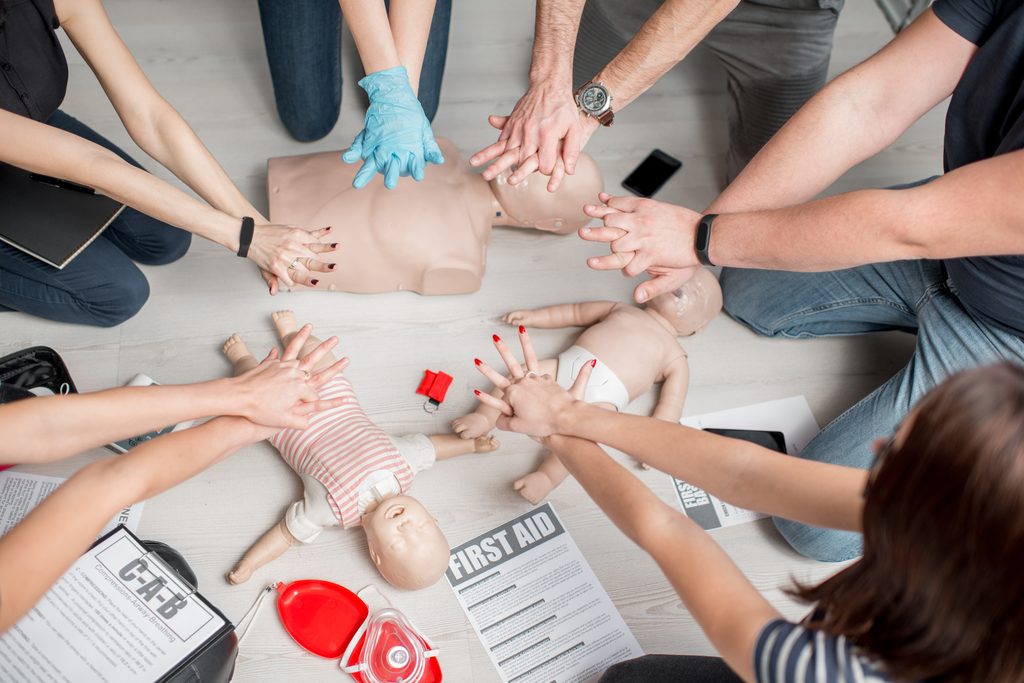
Even when a specific workplace rule does not tell every employee to become CPR certified, having trained staff can strengthen emergency preparedness.
Employers may choose to train people who are likely to be available when an emergency occurs, including:
- Managers
- Supervisors
- Safety personnel
- Reception staff
- Security staff
- HR team members
- Floor leaders
- Fitness or wellness staff
- Employees working in isolated locations
The goal should be practical coverage.
Having one certified person is less useful if that employee works only one shift, frequently travels, or is not normally present in the area where an emergency may occur.
Does OSHA Require CPR Certification?
This question needs careful wording because OSHA does not impose one universal rule saying every employee in every workplace must hold CPR certification.
OSHA’s general industry standard states that when there is no infirmary, clinic, or hospital in near proximity to the workplace, a person or persons must be adequately trained to render first aid.
Other OSHA standards or industry-specific requirements can also apply depending on the workplace.
That means employers should evaluate the rules relevant to their operations instead of relying on a generic statement such as “OSHA requires everyone to have CPR.”
If compliance is the reason you are booking training, confirm the regulation and course requirement that applies to your workplace.
For a deeper compliance-focused explanation, review our guide to OSHA CPR and First Aid requirements.
Which Employees Should Be CPR Certified?
A workplace should think about coverage, not just numbers.
Ask which employees are most likely to be present throughout operating hours.
Potential candidates include:
Managers and Supervisors
Managers are often present during emergencies and may coordinate the workplace response until EMS arrives.
Front-Desk and Reception Staff
These employees may be among the first to learn that someone needs help.
Safety Staff
Employees assigned emergency-response or safety responsibilities are natural candidates for CPR/AED and First Aid training.
Security Personnel
Security employees often respond quickly to incidents throughout a building or campus.
Employees in Remote Work Areas
If workers are located far from immediate medical response, emergency preparation becomes particularly important.
General Employees
Some businesses choose broader staff training rather than relying only on designated responders.
Comfi-Kare’s article on careers where CPR certification matters provides additional examples of jobs where emergency-response skills are valuable.
What Type of CPR Certification Is Best for Employees?
The right course depends on what your employees do.
For many non-healthcare workplaces, training may include:
- Adult CPR
- AED use
- Choking response
- First Aid
Healthcare settings may require BLS or other healthcare-provider-level credentials instead.
Employers should not assume that the most advanced-sounding course is automatically the correct one.
Confirm:
- Your industry’s requirements
- The employee’s job duties
- Employer policies
- Contract requirements
- Licensing requirements, if applicable
- The certification organization the employer accepts
CPR/AED and First Aid for Workplace Employees
CPR prepares employees to respond to cardiac arrest.
AED training teaches them how to use an Automated External Defibrillator.
First Aid expands emergency preparation to other common workplace incidents.
Depending on the workplace, that may include responding appropriately to:
- Bleeding
- Burns
- Falls
- Sudden illness
- Injuries
- Other medical emergencies
Businesses seeking broader emergency preparation can review Comfi-Kare’s AHA Heartsaver Basic First Aid training.
Why Every Workplace Should Think About AED Response
Buying an AED is only one part of preparedness.
Employees also need to know where the device is located and what to do if someone suddenly collapses.
A workplace response plan should consider questions such as:
- Where is the AED?
- Can employees access it immediately?
- Who is trained to use it?
- Who calls 911?
- Who meets emergency responders?
- Are employees trained across different shifts?
- Is emergency equipment inspected and maintained appropriately?
An AED stored somewhere no employee can quickly locate is far less useful than one incorporated into a clear emergency-response plan.
How Many Employees Should Be CPR Certified?
There is no useful one-size-fits-all number for every workplace.
A small office and a large warehouse have very different staffing patterns.
Instead of choosing an arbitrary number, employers should consider:
- Number of employees
- Number of shifts
- Building size
- Worksite layout
- Remote work areas
- Employee turnover
- Travel schedules
- Relevant workplace hazards
- Access to emergency medical services
- Applicable safety requirements
The goal is to have appropriate emergency coverage when employees are actually working.
If only one person is trained and that employee is absent, the workplace may effectively have no trained responder available.
Individual CPR Classes vs Onsite Group Training
If one employee needs certification, sending that person to a scheduled class may make sense.
If ten, twenty, or more employees need training, onsite group instruction may be easier.
Benefits of workplace group training can include:
- Less employee travel
- Easier scheduling
- Multiple staff trained together
- Consistent instruction
- Opportunity to discuss workplace-specific response issues
- Easier coordination of renewal dates
Comfi-Kare CPR offers training for individuals as well as organizations that need group instruction.
Businesses can also review Comfi-Kare’s guide on how to choose the right CPR training provider before scheduling a course.
CPR Training for Gyms and Fitness Businesses
Some workplaces face unique emergency-response considerations.
Gyms, fitness studios, and athletic facilities are good examples because employees regularly supervise people engaged in physical activity.
Fitness businesses should consider whether trainers, instructors, managers, and other employees have appropriate CPR/AED preparation.
For fitness-specific guidance, see CPR Certification for Personal Trainers and Coaches: What Certification Do You Need?.
This allows employers to understand workplace-wide preparation while trainers can separately review their profession-specific certification needs.
How Often Does Workplace CPR Certification Need to Be Renewed?
Certification renewal depends on the specific credential employees hold.
Employers should maintain records showing:
- Who is certified
- Which course they completed
- When the credential expires
- When renewal should be scheduled
Waiting until multiple cards have expired can create unnecessary scheduling pressure.
For group training, businesses may find it easier to coordinate renewal dates so employees can recertify together.
Workplace CPR Training in Maryland
Maryland employers looking for CPR training should begin by identifying what type of credential their employees need.
Before booking:
- Determine whether a specific regulation applies.
- Identify which employees should receive training.
- Confirm the required certification type.
- Decide whether First Aid should be included.
- Determine whether onsite group instruction is more practical.
- Confirm certification acceptance before registration.
Avoid selecting a course based only on price or convenience.
The credential needs to satisfy the reason employees are taking the class in the first place.
Comfi-Kare’s guide to choosing CPR training near you provides a practical checklist for evaluating training providers.
Building a Better Workplace Emergency Plan
CPR training works best as part of a broader emergency-response strategy.
Employers should consider whether staff know:
- When to call 911
- How to recognize an emergency
- Where First Aid supplies are kept
- Where the AED is located
- How to access emergency equipment
- Who is responsible for responding
- How emergency responders enter the workplace
Training several employees can also help avoid relying on one person to be available at all times.
Frequently Asked Questions
Does OSHA require CPR training for every workplace?
No single OSHA rule requires every employee in every workplace to have CPR certification. OSHA’s general industry first-aid standard does require adequately trained first-aid personnel in certain circumstances when medical facilities are not in near proximity. Employers must evaluate the rules applicable to their workplace.
Does every workplace need CPR-certified employees?
Needs and requirements differ by workplace. Businesses should consider applicable regulations, hazards, staffing, access to medical services, and internal safety policies.
Can employers require CPR certification?
Employers may establish training or certification requirements for particular positions, subject to applicable employment rules and industry requirements.
What CPR course should office employees take?
Many non-healthcare employees use CPR/AED and First Aid-level training. The correct course depends on the employer’s requirements.
Can CPR training be done at the workplace?
Yes. Group or onsite training can be an efficient option when multiple employees need instruction.
How many employees should be trained?
Rather than relying on one universal number, employers should consider shifts, workplace size, availability, hazards, and relevant requirements so appropriate coverage is available.
Schedule Workplace CPR Training in Maryland
Effective CPR certification for workplace employees is about more than collecting certification cards.
It is about building a team that knows what to do when an emergency occurs.
Whether you need to train one employee or an entire staff, Comfi-Kare CPR can help Maryland organizations identify appropriate CPR, AED, First Aid, and group-training options.
Preparing before an emergency is far easier than figuring out the response while one is happening.