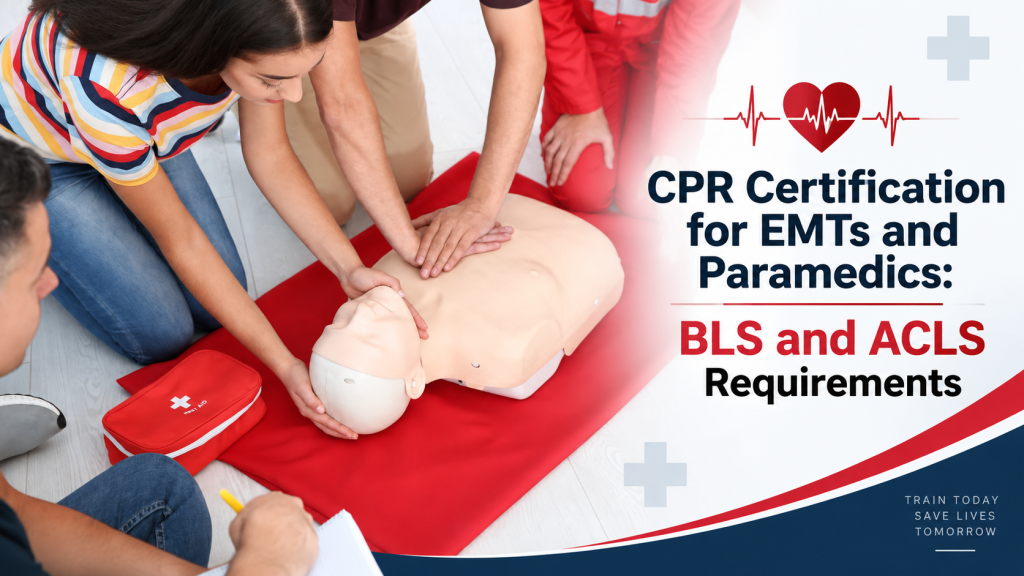
EMTs and paramedics work in environments where CPR and emergency cardiovascular care are part of patient response. EMTs commonly rely on BLS-level resuscitation skills, while paramedics and other advanced EMS clinicians may also need ACLS and, depending on their role, PALS. The exact credential can differ by EMS agency, employer, training program, state requirements, and certification body.
For the broader differences among CPR credential levels, testing, validity, and renewal, read our guide to CPR certification and renewal.
EMTs and paramedics should not assume that every CPR card meets their professional requirement. Before registering for a course, check the exact credential, training organization, and course format requested by your EMS agency, employer, school, or licensing authority.
Do EMTs and Paramedics Need CPR Certification?
CPR and resuscitation skills are central to emergency medical services because EMS clinicians may be among the first medical responders caring for a patient in cardiac arrest, respiratory arrest, or another life-threatening emergency.
For EMTs, Basic Life Support skills form a major part of prehospital emergency response. The American Heart Association’s BLS course is specifically designed for healthcare professionals and trained responders working in both in-hospital and out-of-hospital settings. It includes individual and team-based resuscitation skills.
However, the exact certification card an EMT needs should still be confirmed with the organization setting the requirement.
For example, Maryland’s current rules for initial EMT certification require completion of an EMS Board-approved EMT course, a MIEMSS-approved internship, active National Registry EMT status, and affiliation with an EMS operational program. Maryland’s requirements for paramedic licensure are different and include an approved paramedic education pathway, specified patient-care experience, National Registry paramedic status, protocol orientation, and affiliation with an ALS EMS operational program.
That is why EMT and paramedic credential requirements should not be treated as identical.
What CPR Certification Does an EMT Need?
EMTs generally work at the Basic Life Support level of emergency medical care. For CPR training, that usually means a healthcare-provider or professional-rescuer BLS course rather than a basic CPR class designed for the general public.
A BLS course can include training related to:
- High-quality CPR
- Adult, child, and infant response
- AED use
- Ventilation
- Multi-rescuer CPR
- Team-based response
- Recognition of life-threatening emergencies
The AHA’s current BLS Provider course is designed for both in-hospital and out-of-hospital care and teaches single-rescuer and team BLS skills.
An EMT student or working EMT should still check the exact card requested by the training program, EMS agency, employer, or state authority.
If an organization asks specifically for an AHA BLS Provider card, a general online CPR certificate should not automatically be treated as an equivalent credential.
BLS Certification for EMTs
BLS closely matches the type of resuscitation work EMTs may encounter in prehospital emergencies.
The course provides the foundation for responding to cardiac arrest and other life-threatening situations while working individually or as part of a response team. It also addresses CPR and AED use in out-of-hospital settings, which makes it directly relevant to EMS professionals.
EMTs may apply BLS concepts while:
- Responding to cardiac arrest
- Supporting ventilation
- Using an AED or working around defibrillation
- Providing coordinated CPR with another responder
- Moving between patient assessment and emergency interventions
- Communicating with other EMS or healthcare professionals
This article does not replace formal EMT or BLS instruction. EMS clinicians should follow their approved protocols, medical direction, and professional training when treating patients.
For more information about the BLS course itself, read our BLS guidance for emergency responders.
Does a Paramedic Need ACLS Certification?
Paramedics operate at an advanced level of prehospital care, so their training can include management of cardiac arrest, cardiac rhythms, airway emergencies, and other serious cardiovascular conditions.
The American Heart Association identifies paramedics among the healthcare professionals for whom its ACLS Provider Course is designed. The course is intended for professionals who direct or participate in the management of cardiopulmonary arrest and other cardiovascular emergencies.
Because of this, ACLS is commonly associated with paramedic and advanced EMS roles.
That does not mean every paramedic in every jurisdiction automatically has the same ACLS card requirement. The actual requirement can come from:
- An EMS agency
- Employer policy
- Medical direction
- A paramedic education program
- State or local EMS requirements
- A hospital-based EMS system
- Another credentialing organization
Paramedics should check what their agency or licensing authority currently accepts before registering.
For more information about advanced cardiovascular training, read our ACLS guide.
The AHA also states that ACLS builds on BLS skills. A current BLS Provider card is not universally required by the AHA before an ACLS course, although students are expected to be proficient in BLS and individual Training Centers may require a current BLS card.
When Do EMTs or Paramedics Need PALS?
EMS professionals can also respond to medical emergencies involving infants and children.
PALS focuses on pediatric respiratory emergencies, shock, arrhythmias, and cardiopulmonary arrest. The American Heart Association identifies paramedics and other emergency-response professionals among the intended audience for PALS.
A paramedic may be asked to maintain PALS when pediatric emergency response is part of the position or when an EMS agency requires the credential.
Whether an EMT needs PALS can be more dependent on agency policy, scope, training level, and local requirements. EMTs should not register for PALS simply because they work in EMS unless their employer, program, or credentialing organization requests it.
EMS professionals who need pediatric advanced life-support training can read our PALS training guidance.
EMT vs. Paramedic CPR Requirements
EMTs and paramedics both work in prehospital emergency medicine, but they do not have identical education, scope, or credentialing requirements.
At a high level, EMT training is built around Basic Life Support emergency care. Paramedic training includes advanced-level patient care and can involve advanced cardiovascular and pediatric emergency management.
Maryland regulations demonstrate this distinction clearly.
Initial Maryland EMT certification requires an approved EMT course, internship, National Registry EMT status, and EMS operational-program affiliation.
Initial Maryland paramedic licensure includes an approved paramedic pathway, qualifying patient-care experience, National Registry paramedic status, MIEMSS protocol orientation, and affiliation with an ALS EMS operational program.
Those state credential requirements should not be confused with a separate BLS, ACLS, or PALS course completion card.
An EMS professional may need to maintain several credentials at the same time, and the agency or employer can specify which cards are accepted.
CPR Skills Commonly Applied in Prehospital Emergencies
Prehospital emergencies require responders to work quickly and communicate clearly while caring for patients in uncontrolled environments.
CPR-related training for EMS professionals can involve:
- High-quality CPR
- Coordinated team response
- AED or defibrillation support
- Airway and ventilation support
- Switching rescuers during prolonged response
- Communication among responders
- Movement from initial care to transport
- Transfer of patient care to hospital teams
The AHA’s BLS program specifically covers individual and team response in both healthcare facilities and prehospital settings.
ACLS builds from that BLS foundation for professionals involved in advanced adult cardiovascular emergencies, while PALS focuses on serious pediatric emergencies.
EMS clinicians should learn and practice these skills through approved professional training rather than relying on written material alone.
Do EMT Students Need CPR Certification Before Training?
Whether an EMT student must already hold a CPR or BLS card before beginning a program depends on the school or training program.
Some programs may include the required resuscitation training within the EMT curriculum. Others can require students to arrive with a particular BLS Provider or professional-rescuer credential.
This is an area where students should check the admissions or clinical requirements before buying a course.
Ask the EMT program:
- Do I need BLS before the program begins?
- Which training organization must issue the card?
- Does the course need a hands-on skills component?
- Can the BLS course be completed as part of the EMT program?
- How current must the card remain during clinical or field training?
In Maryland, initial EMT applicants must complete an EMS Board-approved EMT course and a MIEMSS-approved internship, along with the other state certification requirements.
Students should follow the requirements issued by the particular approved training program they plan to attend.
How Often Do EMTs and Paramedics Need Recertification?
It is important to separate EMS certification renewal from BLS, ACLS, or PALS card renewal.
National Registry EMTs and paramedics work on certification cycles that generally require recertification every two years. The continuing-education requirements differ by EMS level. Under the current National Continued Competency Program, EMT recertification requires 40 education hours, while paramedic recertification requires 60.
AHA BLS, ACLS, and PALS course completion cards also generally have a two-year renewal period, but those cards are separate from National Registry certification.
An EMS professional therefore needs to monitor each credential separately.
For example, an EMT or paramedic may need to track:
- State certification or licensure
- National Registry certification
- BLS card expiration
- ACLS card expiration, when applicable
- PALS card expiration, when applicable
- Agency training requirements
- Local protocol education
Do not assume that renewing one credential renews the others.
BLS, ACLS, and PALS Classes for EMS Professionals in Maryland
Comfi-Kare CPR offers American Heart Association BLS, ACLS, and PALS training in Maryland.
Its current course offerings include BLS, ACLS, PALS, BLS skills sessions, ACLS skills sessions, and combined course options. Comfi-Kare also offers group training sessions and lists EMS among the clinical settings associated with ACLS training.
Training is available from Comfi-Kare’s Silver Spring location, with service across Montgomery County and other Maryland communities.
EMTs and paramedics should first verify the course required by their:
- EMS agency
- Employer
- Training program
- Medical director
- State credentialing authority
After confirming the credential, they can select the appropriate BLS, ACLS, or PALS course.
CPR Training for EMTs, Paramedics, and EMS Teams in Maryland
Need BLS, ACLS, or PALS for an EMS position or training program?
Comfi-Kare CPR provides American Heart Association training for emergency responders and healthcare professionals in Maryland. Individual EMTs and paramedics can register for the credential requested by their agency or employer, while EMS organizations can contact Comfi-Kare about group training options.
Check the credential you need first, then contact Comfi-Kare CPR for the appropriate BLS, ACLS, or PALS course.
Frequently Asked Questions
Is BLS required for EMTs?
BLS-level resuscitation skills are closely tied to EMT practice and prehospital emergency response. However, the exact BLS card or training provider required can depend on the EMT program, EMS agency, employer, or state. EMTs should confirm the specific credential requested before registering.
Do paramedics need ACLS certification?
ACLS is commonly associated with paramedic and advanced EMS work. The AHA identifies paramedics among the professionals for whom ACLS is designed, but the actual job or licensing requirement should be confirmed with the EMS agency, employer, program, or state authority.
Do EMTs need PALS?
Not every EMT automatically needs PALS. PALS may be requested for EMS professionals whose role includes pediatric emergency response. Paramedics are specifically included among the intended audiences for the AHA PALS course.
Is CPR certification required before EMT school?
It depends on the EMT training program. Some programs may ask students to hold a particular BLS or professional-rescuer credential before beginning class or clinical training, while others may provide the training within the program. Check directly with the school before registering.
What CPR card do EMT programs typically ask for?
Programs can specify the card and provider they accept. Healthcare-provider BLS is commonly associated with EMS training, but students should follow the exact wording supplied by their school rather than choosing a course only because it says “CPR certification.”
How long does BLS certification last for EMS professionals?
AHA BLS Provider course completion cards generally carry a two-year renewal date. This is separate from EMT or paramedic state licensing and National Registry recertification requirements.