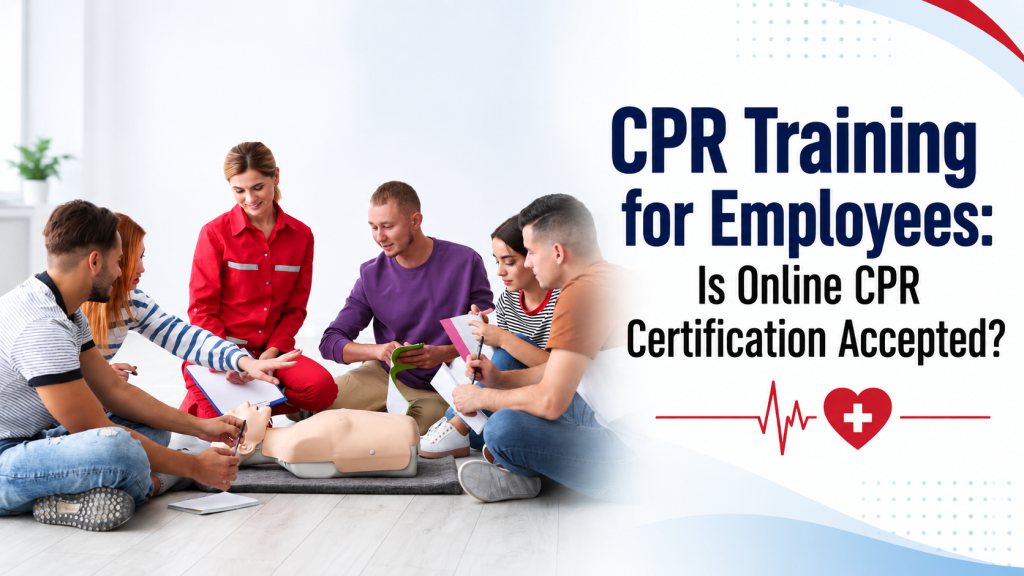
When an employer asks workers to become CPR certified, one of the first questions is often whether they can simply complete the course online.
The answer depends on the job, the employer, and the exact certification required.
CPR training for employees can come in several formats: fully online training, blended learning that combines online coursework with a hands-on skills session, and instructor-led classroom training.
Those formats are not interchangeable for every workplace.
A hospital employee who needs an American Heart Association BLS Provider card may have very different requirements from an office employee whose company simply wants staff trained in CPR and AED response.
Before registering, employees and employers should understand the differences between online vs. in-person CPR certification options.
The most important rule is simple: check the exact certification your employer requires before choosing a class.

Do Employers Accept Online CPR Training for Employees?
Some employers may accept certain forms of online CPR education, while others require a recognized course completion card that includes hands-on skills training.
There is no single CPR certification requirement that applies to every job.
The correct CPR training for employees may depend on:
- The employee’s profession
- Workplace safety requirements
- State or licensing requirements
- Employer policy
- Whether the employee works directly with patients
- Whether CPR certification is mandatory for the position
- Which training organization the employer accepts
Healthcare employers commonly ask for specific certifications such as BLS, ACLS, or PALS.
Other workplaces may require Heartsaver CPR AED or Heartsaver First Aid CPR AED.
The American Heart Association recommends that students who need certification for work confirm the appropriate course with their employer before registering.
For non-healthcare workers, the AHA’s Heartsaver workplace training programs include CPR, AED, and First Aid options intended for workplace training and job requirements.
The wording matters.
If your employer says AHA BLS Provider, taking a general CPR course from an unrelated website may not meet the requirement even if the website gives you a CPR certificate.
Why Some Employers Reject Online-Only CPR Cards
CPR is not only knowledge.
It is a physical skill.
Someone can learn compression rate, hand placement, AED steps, and rescue breathing from a screen, but an online-only course cannot always show whether that person can perform those skills correctly.
That distinction matters for jobs where employees may actually be responsible for responding to a cardiac or respiratory emergency.
OSHA has addressed this issue directly for workplace standards that require CPR or First Aid training.
According to OSHA guidance on online CPR training, online-only instruction does not satisfy the specific standards discussed in its interpretation because CPR and First Aid involve physical skills that must be practiced.
That does not mean every job in the United States has the same CPR requirement.
It means employers should not assume that any online certificate automatically meets workplace training requirements.
For CPR training for employees, the actual credential and hands-on requirements matter.
Online-Only vs. Blended CPR Training for Employees
People often use the term “online CPR” to describe very different course formats.
Online-Only CPR Training
An online-only course is completed remotely.
The employee watches lessons, reads material, and may complete an online exam without attending a physical skills session.
Some websites provide a certificate after completion.
Whether an employer accepts that certificate depends on the employer’s requirement.
An online certificate should not automatically be treated as the equivalent of an AHA course completion card.
Blended CPR Training
Blended learning combines online coursework with hands-on training.
The employee completes the cognitive part remotely and then attends a skills session to practice and demonstrate physical techniques.
The American Heart Association currently offers blended-learning options for both healthcare and workplace courses.
For workforce training, AHA Heartsaver programs can combine online learning with a hands-on skills session. The AHA describes its blended format as an online portion followed by hands-on training.
You can review the AHA’s Heartsaver CPR and First Aid course options to see how classroom, blended, virtual, and other training formats differ.
Instructor-Led CPR Training
With instructor-led training, the learning and hands-on components take place during a class with an instructor.
Participants can practice CPR, AED use, rescue breathing, and other applicable skills while receiving direct feedback.
For companies arranging CPR training for employees, classroom or onsite group training can also be practical when several workers need certification at the same time.
When Is an In-Person Skills Check Required?
A skills check is commonly required when an employee is completing a blended course that includes physical CPR skills.
The online portion teaches the material.
The skills session tests whether the student can physically perform the required techniques.
Depending on the course, this can include:
- Adult CPR
- Child CPR
- Infant CPR
- Chest compressions
- Rescue breathing
- AED use
- Choking response
- Bag-mask ventilation
- Team CPR
Healthcare workers completing HeartCode BLS, for example, need the corresponding hands-on component to complete their BLS course requirements.
Comfi-Kare CPR offers a BLS skills session in Maryland for students who need to complete the hands-on portion of their BLS training.
The session includes CPR and AED practice, bag-mask ventilation, choking response, and team-based skills.
Which Jobs Commonly Require Hands-On CPR Training?
The type of CPR training for employees depends heavily on the occupation.
Hands-on training is especially common in healthcare, emergency response, childcare, education, fitness, and other roles where an employee may need to respond directly during an emergency.
Healthcare Employees
Healthcare workers commonly need BLS rather than a basic workplace CPR course.
This can include:
- Registered nurses
- LPNs
- CNAs
- Physicians
- Medical assistants
- Dental professionals
- Respiratory therapists
- Nursing students
- Medical students
- EMTs
- Paramedics
- Other clinical staff
Depending on the position, ACLS or PALS may also be required.
Healthcare professionals in Maryland can review Comfi-Kare’s BLS certification for healthcare employees to see what is included in the instructor-led BLS course.
Non-Healthcare Employees
Workers outside healthcare may need a different type of course.
AHA Heartsaver programs are intended for people with little or no medical training who may need CPR, AED, or First Aid instruction for work.
Examples can include:
- Teachers
- Childcare workers
- Coaches
- Personal trainers
- Security staff
- Construction workers
- Hospitality employees
- Manufacturing workers
- Office staff
- Community organization employees
The AHA specifically identifies workforce groups such as childcare, health and fitness, hospitality, manufacturing, retail, restaurants, and security among the audiences for Heartsaver training.
CPR Training for Employees in Healthcare
Healthcare employers often give workers a very specific certification requirement.
If your employer asks for AHA BLS Provider, you should register for BLS rather than selecting a course simply because it contains the words CPR or AED.
BLS includes CPR, but it also covers additional skills used by healthcare professionals and trained responders.
Comfi-Kare’s BLS program includes adult, child, and infant CPR, AED use, emergency response, and skills testing.
Employees can review the Basic Life Support certification course before registering.
Healthcare professionals should also verify whether their position requires:
- BLS
- ACLS
- PALS
- First Aid
- Bloodborne Pathogens training
- A combination of certifications
Course requirements can differ between hospitals, facilities, clinical programs, and employers.
How to Confirm What Your Employer Will Accept
Before paying for CPR training for employees, ask the employer for the exact certification requirement.
Questions should include:
- What is the exact name of the CPR course required?
- Does it need to be an American Heart Association course?
- Is a hands-on skills session required?
- Does the employee need BLS or Heartsaver?
- Is First Aid required as well?
- Does the position require ACLS or PALS?
- Does the employer require a course completion eCard?
- When must the certification be completed?
- When does it need to be renewed?
If the employer gives you the name of a specific credential, register for that credential rather than choosing a course based only on convenience or price.
The American Heart Association’s course catalog also tells workers to contact their employer to confirm that they are selecting the correct course.
Choosing CPR Training for Employees in Maryland
Comfi-Kare CPR provides American Heart Association CPR and life-support training in Maryland for healthcare professionals, students, caregivers, teachers, workplace employees, and other participants.
Available courses include:
- Basic Life Support
- Advanced Cardiovascular Life Support
- Pediatric Advanced Life Support
- Heartsaver First Aid
- Heartsaver First Aid CPR AED
- BLS skills sessions
- ACLS skills sessions
Employers and individual workers can compare CPR courses and certifications in Maryland before registering.
The best course depends on the job.
A nurse may need BLS.
An ICU or emergency employee may also need ACLS.
A worker caring for pediatric patients may need PALS.
A teacher, childcare worker, coach, or nonclinical employee may need a Heartsaver course instead.
Choosing CPR training for employees based on the actual job requirement can prevent workers from completing a course only to find out later that their employer requested a different certification.
Can Employers Book Group CPR Training for Employees?
Yes.
When several employees need CPR certification, companies may prefer to train staff as a group rather than having every employee find a separate class.
Group training can work well for:
- Medical offices
- Dental practices
- Home care companies
- Childcare centers
- Schools
- Fitness centers
- Security companies
- Construction companies
- Restaurants
- Hotels
- Community organizations
- Other businesses
Comfi-Kare CPR offers onsite group CPR training in Maryland and can provide group training sessions at the workplace or another preferred location.
For businesses with several employees who need training, an onsite class can make scheduling easier and allow team members to complete the required training together.
Why Hands-On CPR Training Matters in the Workplace
During a cardiac emergency, employees may have only minutes to act before emergency medical services arrive.
Knowing what CPR is does not necessarily mean someone is ready to perform it.
Hands-on training gives employees an opportunity to practice chest compressions, AED use, rescue breathing, and emergency response steps rather than seeing them only on a screen.
This is one reason AHA workforce programs include training formats with physical practice.
AHA Heartsaver First Aid CPR AED courses are designed for people with little or no medical training who need CPR and First Aid training for job or regulatory requirements. Course completion cards for qualifying Heartsaver programs are valid for two years.
For employers, the goal of CPR training for employees should not simply be collecting certificates.
Workers should leave training knowing what to do if someone collapses, stops breathing normally, or needs an AED.
Frequently Asked Questions
What is the best CPR training for employees?
The correct course depends on the employee’s job and employer requirements. Healthcare professionals may need BLS, ACLS, or PALS. Many non-healthcare employees may need an AHA Heartsaver CPR AED or First Aid CPR AED course.
Can CPR training for employees be completed online?
Some coursework can be completed online through blended-learning programs. However, many certifications include a hands-on skills component. Employees should confirm the exact requirement with their employer before choosing an online-only course.
Do employers accept online CPR certification?
Some employers may accept certain online training, but others require a specific certification with hands-on skills testing. Healthcare employers commonly specify the exact BLS, ACLS, or PALS credential required.
Is an online CPR certificate the same as an AHA card?
No. A certificate issued by an online training website is not automatically an American Heart Association course completion card. If your employer requests an AHA credential, confirm that the course you choose leads to the correct AHA eCard.
What CPR training do healthcare employees need?
Many healthcare employees need BLS. Some positions also require ACLS or PALS. The exact requirement depends on the employer and job responsibilities.
What CPR training do non-healthcare employees need?
Many workplace employees can take an AHA Heartsaver course. Options include CPR AED, First Aid CPR AED, Pediatric First Aid CPR AED, and other workplace programs.
Can CPR training for employees be done at the workplace?
Yes. Employers with several workers who need certification can arrange group training. Comfi-Kare CPR offers group CPR training sessions at workplaces and other preferred locations in Maryland.
How long is employee CPR certification valid?
AHA course completion cards for programs such as Heartsaver and BLS are generally valid for two years. Employees should also follow any workplace, licensing, or regulatory renewal requirements.