If you completed an online CPR, BLS, ACLS, or PALS course and were told you still need a CPR skills check, that does not mean you have to repeat everything you already learned.
The online portion and the hands-on portion serve different purposes.
The online portion teaches the course material. During a CPR skills check, you physically demonstrate the techniques required for the certification.
Some CPR courses are completed entirely in a classroom. Others use blended learning, where students complete online coursework first and then attend a hands-on session.
If you are not sure how those formats differ, Comfi-Kare’s guide to CPR training formats and certification options explains the differences between classroom, blended, and online-only CPR training.
For American Heart Association HeartCode courses, the hands-on portion is a required part of completing the blended-learning course. AHA states that HeartCode combines online learning with hands-on CPR skills practice, followed by skills testing with an AHA Instructor or an approved compatible manikin system.
What Is a CPR Skills Check?
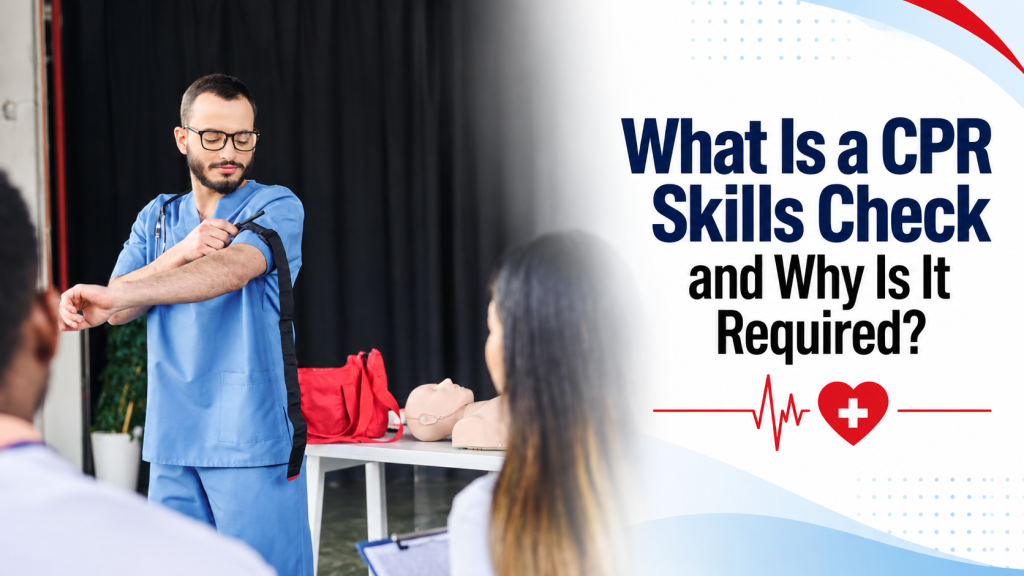
A CPR skills check is a practical session where a student demonstrates that they can physically perform the lifesaving techniques required by the course.
Instead of answering questions on a screen, you perform the skills on a manikin or take part in a simulated emergency scenario.
Depending on the certification, you may be asked to demonstrate:
- Chest compressions
- Rescue breathing
- AED use
- Adult CPR
- Child CPR
- Infant CPR
- Choking response
- Bag-mask ventilation
- Team communication
- Airway management
- Rhythm recognition
- Advanced resuscitation scenarios
A BLS skills check will not look exactly like an ACLS or PALS skills session.
The course determines which physical skills and scenarios must be completed.
For HeartCode training, the CPR skills check is part of the course, not an optional extra after the online portion. The AHA describes blended learning as online coursework followed by a hands-on skills session.
What Happens During a CPR Skills Session?
The exact session depends on the course you are completing.
For BLS, students typically practice and demonstrate high-quality CPR, ventilations, AED use, choking response, and team-based resuscitation.
Comfi-Kare’s BLS Skills Session in Maryland includes hands-on practice for adult, child, and infant CPR, AED use, bag-mask ventilation, choking response, and team communication.
Participants practice on feedback manikins and receive guidance while working through the required techniques.
A student may understand from the online course that chest compressions must be delivered correctly, but physical practice can reveal problems that are difficult to recognize while studying.
For example:
- Compressions may be too shallow.
- The compression rate may be too fast or too slow.
- Chest recoil may be incomplete.
- Ventilations may not be delivered correctly.
- AED steps may be performed out of sequence.
- Team communication may become unclear during a scenario.
A CPR skills session gives the student an opportunity to work through those physical elements before completing the skills test.
Why Hands-On Skills Testing Matters
CPR is a physical skill.
Knowing what to do and being able to perform it correctly are not always the same thing.
During an emergency, the responder may need to position the patient, begin compressions, provide breaths, operate an AED, and communicate with other responders within a short period of time.
Hands-on practice allows students to physically perform those steps rather than only reading about them.
This distinction is also recognized in workplace training guidance.
OSHA has stated that online-only CPR and first-aid training does not meet the specific OSHA standards addressed in its interpretation because these physical skills need actual practice.
You can read the OSHA guidance on hands-on CPR training for the agency’s explanation.
For healthcare professionals, physical skills testing is particularly important because many certifications involve responding as part of a clinical team.
Online CPR Course vs. Skills Check
The online course and the CPR skills check are two parts of blended training.
The Online Portion
The online section primarily covers knowledge.
Depending on the course, this may include:
- Cardiac arrest recognition
- CPR sequences
- AED operation
- Airway emergencies
- Emergency algorithms
- Rhythm recognition
- Medication concepts
- Team roles
- Clinical decision-making
Students work through the course material and complete the required online assessments.
The Skills Check
The skills portion asks you to physically demonstrate what you learned.
For HeartCode BLS, the AHA describes the format as independent online learning followed by a structured hands-on session focused on meaningful skills practice, team scenarios, and skills testing.
You can review the AHA HeartCode BLS course format for the current course requirements.
Completing the online portion alone therefore does not mean you have finished the entire HeartCode course.
Who Usually Needs a CPR Skills Check?
A CPR skills check is commonly needed by students taking blended AHA training.
This frequently includes:
- Nurses
- Physicians
- CNAs
- Medical assistants
- EMTs
- Paramedics
- Dental professionals
- Respiratory therapists
- Nursing students
- Medical students
- Allied health professionals
- Other clinical personnel
The certification required depends on the person’s role.
Many healthcare professionals need BLS.
Employees involved in advanced cardiovascular emergencies may also need ACLS.
Professionals who regularly respond to pediatric emergencies may need PALS.
Students should always confirm the exact course requested by their employer, school, clinical program, or licensing body before registering for a skills session.
BLS, ACLS and PALS Skills Sessions
The term “skills check” can apply to several courses, but the content is different for BLS, ACLS, and PALS.
BLS Skills Check
BLS focuses on core lifesaving skills.
Students may demonstrate:
- Adult CPR
- Child CPR
- Infant CPR
- AED use
- Rescue breathing
- Bag-mask ventilation
- Choking response
- Team CPR
If you have completed the applicable online portion, you can review Comfi-Kare’s BLS hands-on skills session for hands-on BLS testing in Maryland.
Comfi-Kare states that its session includes manikin practice, instructor guidance, skills testing, and the applicable AHA BLS eCard after successful completion.
ACLS Skills Check
ACLS goes beyond basic CPR.
The hands-on portion may involve:
- High-quality CPR
- Rhythm recognition
- Defibrillation
- Synchronized cardioversion
- Airway management
- Ventilation
- Medication decisions
- Team roles
- Megacode scenarios
Students completing HeartCode ACLS can review Comfi-Kare’s ACLS HeartCode Skills Session.
Comfi-Kare’s current ACLS HeartCode session includes advanced cardiac arrest scenarios, airway and ventilation management, rhythm recognition, medication selection, and team-based megacode practice.
PALS Skills Session
PALS is designed for healthcare professionals who respond to emergencies involving infants and children.
Skills can include:
- Pediatric assessment
- Infant and child CPR
- Airway and ventilation management
- Shock management
- Defibrillation and cardioversion
- Pediatric cardiac arrest response
- Team-based pediatric scenarios
Healthcare professionals who need pediatric advanced life support can review Comfi-Kare’s PALS certification training in Maryland.
Comfi-Kare’s PALS training includes scenario-based practice involving respiratory distress or failure, shock, cardiac arrest, airway management, pediatric assessment, and resuscitation team roles.
How Long Does a CPR Skills Check Take?
The length of a CPR skills check depends on which course you are completing.
There is not one standard duration that applies to BLS, ACLS, and PALS.
Current AHA course information lists the HeartCode BLS hands-on portion at approximately 60 minutes to 2 hours, depending on the student’s experience.
Advanced courses take longer because they include additional scenarios and skills.
The AHA currently lists the HeartCode ACLS hands-on session at approximately 6.75 to 7.75 hours with breaks.
HeartCode PALS hands-on training is also longer than a basic BLS skills session because it includes pediatric emergency scenarios, team practice, and additional clinical skills. The AHA currently lists approximately 5 hours and 30 minutes for the HeartCode PALS hands-on session without optional lessons.
Course times can vary based on the course version, class structure, number of participants, student experience, and current AHA course requirements.
Students should check the specific session they are booking rather than assuming every skills check is a short appointment.
CPR Skills Testing in Maryland
If you have already completed the applicable online coursework and need hands-on CPR skills testing in Maryland, your next step is to identify which skills session matches your course.
Do not book a BLS skills check if you need ACLS.
Do not book ACLS if your employer requires PALS.
And do not assume that completing the online part means the certification process is already finished.
Comfi-Kare CPR provides hands-on American Heart Association training in Maryland, including:
- BLS skills sessions
- ACLS HeartCode skills sessions
- BLS certification
- ACLS certification
- PALS certification
- Heartsaver courses
Before registering for a skills session, check:
- Which online course you completed
- Which hands-on session matches that course
- Whether you have your online completion certificate
- Which certification your employer or school requires
- Whether you need an initial certification or renewal
For students completing HeartCode training, having the correct online documentation is important. AHA requires completion of the online portion before the corresponding instructor-led HeartCode skills session.
Choosing the correct session from the beginning can prevent delays in receiving the certification needed for work, school, or clinical placement.
Frequently Asked Questions
Is a CPR skills check the same as a CPR class?
Not exactly. A full instructor-led CPR class includes instruction and hands-on training within the classroom course. A CPR skills check is commonly the physical portion completed after the online section of a blended course such as HeartCode.
Can I get an AHA CPR card without completing the hands-on portion?
For HeartCode courses that include physical CPR skills, the hands-on component is part of completing the course. Students complete the online portion and the required skills session before receiving the applicable AHA course completion card.
What do I need to bring to a CPR skills check?
Requirements can vary by course and training center. Students completing HeartCode should be prepared to show proof that they completed the correct online portion. Check the training provider’s instructions before your appointment.
What happens if I do not pass the CPR skills test?
A skills session is designed to include physical practice and feedback before or during testing according to the course format. If you have difficulty with a required skill, the instructor can identify what needs correction and explain the next steps under the applicable course rules.
Is a BLS skills check the same as an ACLS skills check?
No. BLS focuses on basic life support skills such as CPR, AED use, ventilation, choking response, and team CPR. ACLS includes more advanced cardiac emergency management, rhythms, airway care, medications, and megacode scenarios.
Do I need a separate skills check for PALS?
If you are completing HeartCode PALS through the blended-learning pathway, the applicable hands-on skills session is part of completing the course.
Where can I complete a CPR skills check in Maryland?
Comfi-Kare CPR offers hands-on AHA training in Maryland, including BLS skills sessions and ACLS HeartCode skills sessions. Students should book the session that matches the online course and credential they need.