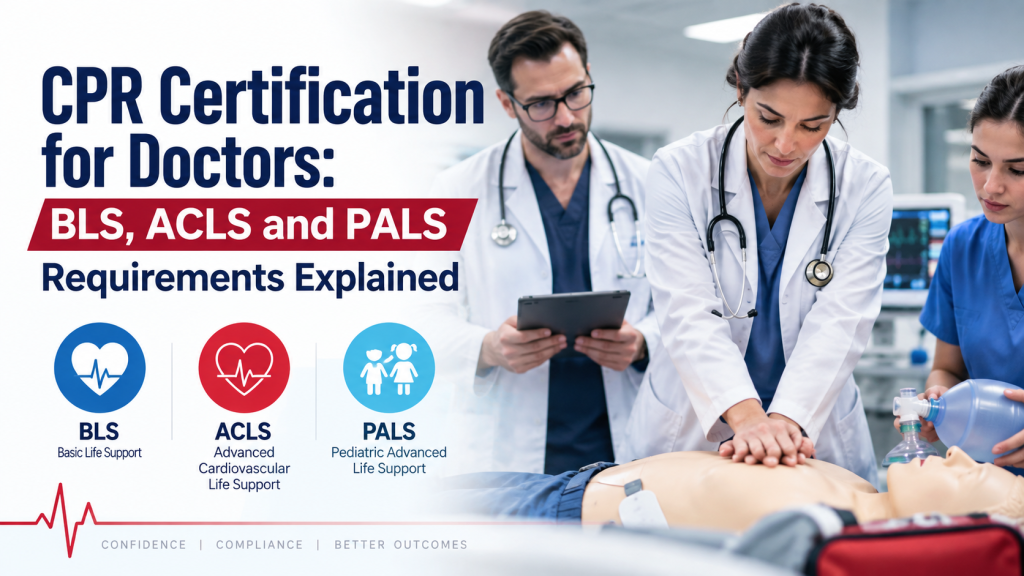
Doctors working in clinical settings commonly maintain Basic Life Support (BLS) training, while some physicians may also need Advanced Cardiovascular Life Support (ACLS), Pediatric Advanced Life Support (PALS), or both. The exact credentials depend on factors such as specialty, employer, hospital privileges, clinical setting, and the patient population a physician treats.
Before selecting BLS, ACLS, or PALS, review our complete CPR certification guide for a broader explanation of course levels, testing, validity, and renewal.
There is no single combination of CPR credentials that applies to every physician. A family physician in an outpatient practice may have different training requirements from an emergency physician, anesthesiologist, intensivist, or pediatrician. Doctors should confirm the exact course and accepted provider with their employer, hospital, credentialing office, residency program, or other organization setting the requirement before registering.

Do Doctors Need CPR Certification?
Physicians frequently work in settings where they may be part of the response to cardiac arrest, respiratory arrest, or another medical emergency. For that reason, healthcare organizations commonly require doctors in patient-care roles to maintain current resuscitation credentials.
However, “CPR certification for doctors” does not describe one universal requirement.
A physician’s required credentials may be set by:
- A hospital or health system
- An outpatient medical practice
- A credentialing or privileging department
- A residency or fellowship program
- A specialty or department
- A surgery or procedural center
- An employer
- A clinical training program
Maryland’s general physician licensure information lists requirements such as medical education, postgraduate training, examinations, English competency, and a criminal history records check. It does not list one universal BLS, ACLS, or PALS credential that every Maryland physician must hold for general physician licensure. Individual employers, hospitals, medical programs, and facilities can still set their own requirements.
That distinction matters. Physicians should verify both their professional licensing requirements and the separate clinical credentials required for their particular job or hospital privileges.
Which CPR Certification Do Physicians Need?
The three credentials doctors are most likely to encounter are BLS, ACLS, and PALS.
BLS — Basic Life Support
BLS covers core resuscitation skills for healthcare professionals, including high-quality CPR, AED use, ventilation, and team response.
ACLS — Advanced Cardiovascular Life Support
ACLS is intended for healthcare professionals who direct or participate in the management of cardiac arrest and other adult cardiovascular emergencies. The American Heart Association identifies physicians working in areas such as emergency medicine, critical care, and surgery among the healthcare professionals who may take ACLS.
PALS — Pediatric Advanced Life Support
PALS is intended for healthcare professionals who manage respiratory emergencies, shock, arrhythmias, and cardiopulmonary arrest in infants and children. Physicians caring for pediatric patients are among the intended audiences.
Some doctors may maintain only BLS, while others may carry BLS plus ACLS, PALS, or both. The physician’s clinical responsibilities should guide which credential is required.
BLS Certification for Physicians
BLS is the basic healthcare-provider resuscitation course many physicians encounter during medical training and clinical employment.
The American Heart Association’s BLS Provider Course is designed for healthcare professionals and trained first responders who provide patient care in a range of settings. It includes CPR, AED use, ventilation, and coordinated response skills.
Physicians taking BLS can expect training related to areas such as:
- High-quality CPR
- Adult, child, and infant response
- AED use
- Ventilation
- Multi-rescuer CPR
- Team roles during resuscitation
Doctors who want more information about the course itself can review our Basic Life Support guide.
BLS should not automatically be treated as interchangeable with a basic CPR class intended for the general public. If a hospital asks for an AHA BLS Provider credential, a physician should register for the specific credential requested rather than choosing a course simply because it includes CPR.
When Do Doctors Need ACLS?
ACLS goes beyond basic CPR and is aimed at healthcare professionals involved in advanced adult cardiovascular emergency care.
The AHA describes ACLS as training for professionals who direct or participate in the management of cardiac arrest, stroke, and other cardiopulmonary emergencies. Physicians, nurses, paramedics, and other professionals working in emergency response, emergency medicine, critical care, intensive care, and surgery are among its intended audiences.
Doctors who may be asked to maintain ACLS can include those working in:
- Emergency departments
- Intensive care
- Critical care
- Anesthesiology
- Hospital medicine
- Surgery
- Procedural settings
- Other acute-care environments
This does not mean ACLS is required for every physician. A doctor’s employer, specialty, hospital, credentialing department, or clinical role should specify whether ACLS is needed.
Physicians comparing advanced cardiac training can read our ACLS guide for more information about the course.
The AHA also notes that although a current BLS Provider card is not universally required by the AHA before taking ACLS, students are expected to be proficient in BLS skills, and individual Training Centers may require a current BLS card.
When Is PALS Needed?
PALS is geared toward healthcare professionals who participate in the care of infants and children during serious respiratory and cardiovascular emergencies.
According to the American Heart Association, the PALS Provider Course is designed for healthcare professionals who direct or participate in pediatric respiratory and cardiovascular emergency care and cardiopulmonary arrest. Physicians, nurses, paramedics, emergency personnel, and critical-care professionals are among the intended audiences.
PALS may be requested for physicians working in areas such as:
- Pediatrics
- Pediatric emergency medicine
- Pediatric intensive care
- Emergency departments that treat children
- Family medicine settings that care for pediatric patients
- Other roles involving acutely ill infants or children
A pediatrician should not assume that PALS is automatically the only credential needed. Likewise, a physician who sometimes sees children should not assume PALS is automatically required. The appropriate credential depends on the doctor’s actual role and the policy of the employer or facility.
Doctors who need more information about pediatric emergency training can review our PALS certification guide.
CPR Requirements by Medical Setting
The medical setting can strongly affect which CPR and life-support credentials a physician is asked to maintain.
Hospitals
Hospital physicians may need BLS and may also be asked for ACLS or PALS based on their department, privileges, and patient population.
For example, emergency medicine and critical-care physicians may encounter ACLS requirements more often because their work includes advanced cardiovascular emergencies.
Outpatient Clinics
A physician practicing primarily in an outpatient office may have different credential requirements. The medical group, employer, insurer, or facility policy may determine which course is accepted.
Urgent Care
Urgent care physicians may treat patients with unexpected respiratory, cardiac, or other acute medical problems. Employers may therefore set BLS or advanced life-support requirements according to the services offered at the location.
Surgery and Anesthesia
Physicians involved in surgery, anesthesia, procedural medicine, or other settings where patients may experience rapid clinical deterioration may be asked to maintain advanced credentials such as ACLS.
Pediatrics
Doctors regularly treating children may be asked to maintain PALS in addition to BLS, particularly in hospital, emergency, or acute pediatric settings.
Specialty, Telehealth, and Administrative Roles
Physicians with limited direct patient contact may face different requirements from doctors providing bedside or procedural care.
The key point is that the physician’s title alone does not determine the correct course. Clinical duties and the requirements of the organization granting employment or privileges matter.
Do Medical Students and Residents Need BLS Certification?
Medical students and residents are another common group searching for CPR certification requirements.
Schools, teaching hospitals, residency programs, and clinical rotation sites may require students or residents to maintain a current BLS Provider card before participating in clinical training.
The AHA states that its BLS Provider Course is intended not only for healthcare professionals but also for people enrolled in healthcare training programs.
The accepted provider and course format can still vary by institution.
Before registering, medical students and residents should check the exact wording provided by their:
- Medical school
- Residency program
- Teaching hospital
- Clinical rotation site
- Graduate medical education office
If the program requests an AHA BLS Provider card, students should select a course that results in that specific credential.
How Often Do Physicians Renew BLS, ACLS, and PALS?
American Heart Association course completion cards such as BLS and ACLS are valid for two years through the end of the month in which the card was issued. AHA PALS Provider cards also carry a two-year validity period.
Physicians should still check their employer or credentialing requirements rather than relying only on the expiration date printed on the card.
A hospital or medical organization may require physicians to keep the credential active without a lapse. Doctors should review the expiration date early enough to schedule renewal before the existing credential expires.
It is also important to confirm the accepted course format and provider before completing a renewal class.
BLS, ACLS, and PALS Classes for Doctors in Maryland
Comfi-Kare CPR offers American Heart Association BLS, ACLS, and PALS courses for healthcare professionals in Maryland.
Current Comfi-Kare course information specifically lists doctors and hospital physicians among the healthcare professionals served. Training is available in Silver Spring and serves participants from Montgomery County and other Maryland communities.
Physicians can select from courses that include:
- BLS
- ACLS
- PALS
- BLS and ACLS training
- ACLS and PALS training
- Skills sessions where available
Comfi-Kare’s current course listings state that successful participants receive official American Heart Association course completion eCards.
Doctors should verify the credential required by their employer, hospital, residency program, or credentialing department before booking a course.
CPR Training for Physicians and Medical Teams in Maryland
Need BLS, ACLS, or PALS for your medical position?
Comfi-Kare CPR provides American Heart Association training for physicians, medical professionals, and healthcare teams in Maryland. Doctors can register for the credential requested by their employer or facility, and medical offices or healthcare groups can contact Comfi-Kare about training options for multiple team members.
Check your required credential first, then contact Comfi-Kare CPR to schedule the appropriate BLS, ACLS, or PALS course.
Frequently Asked Questions
Do doctors need BLS certification?
Many physicians working in clinical settings maintain BLS, and hospitals, employers, medical programs, or credentialing departments may require it. There is not one universal BLS rule that applies to every doctor in every setting. Physicians should verify the exact requirement for their position.
Do physicians need ACLS certification?
Some physicians need ACLS, particularly those who participate in the management of adult cardiac arrest and other cardiovascular emergencies. Emergency medicine, critical care, intensive care, surgery, and similar acute-care roles commonly align with the intended ACLS audience. The employer or facility should confirm whether ACLS is required.
Do pediatricians need PALS?
Pediatricians and other physicians caring for infants and children may be asked to maintain PALS. The AHA designs PALS for healthcare professionals involved in pediatric respiratory and cardiovascular emergencies, but the actual job requirement should be confirmed with the employer or facility.
Is BLS different from regular CPR certification?
Yes. BLS is designed for healthcare professionals and trained responders and includes healthcare-focused CPR, AED, ventilation, and team-response skills. A basic CPR course intended for the general public may not meet a hospital’s BLS Provider requirement.
Do medical students need BLS before clinical rotations?
Many medical schools and clinical programs may require current BLS before students enter clinical training, but requirements differ by institution and rotation site. Students should confirm the accepted provider and course with their school or clinical program before enrolling.
How long are BLS, ACLS, and PALS certifications valid?
American Heart Association BLS, ACLS, and PALS course completion cards are generally valid for two years. Physicians should also follow any earlier renewal deadline set by their employer, hospital, residency program, or credentialing department.