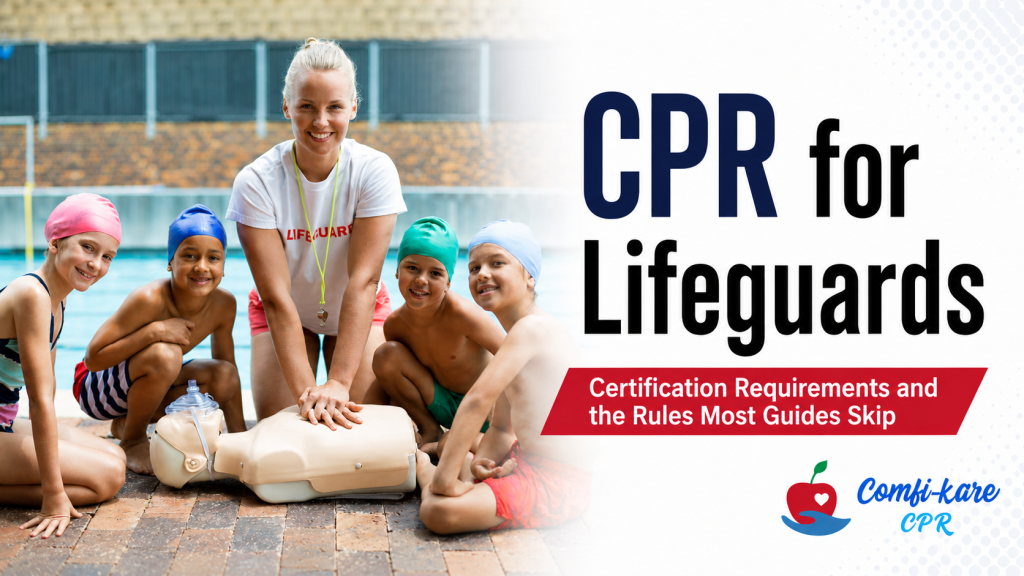
Most CPR content is written for cardiac arrest. A person collapses, their heart stops, someone starts compressions. That’s not what a lifeguard is usually responding to.
CPR for lifeguards starts with a different problem: someone who stopped breathing before their heart stopped. That single difference changes what gets taught, how certification works, and why most general CPR guides miss the details that actually matter for pool and beach staff. This guide covers CPR certification for lifeguards from the ground up, including the parts most training pages leave out.
Key Takeaways
- Drowning is a breathing problem first, not a heart problem first. That changes how CPR is taught.
- Lifeguard certification almost always already includes CPR, AED, and first aid as one package.
- AEDs need dry skin and no standing water nearby to work safely and correctly.
- Many pools require annual refreshers, even though the CPR card itself is valid for two years.
- Pools often staff in pairs partly so CPR can be done as a team, not solo.
What Is CPR for Lifeguards, and How Is It Different From Standard CPR?
In most cardiac arrest cases, the heart stops first and the person still has some oxygen in their blood. That’s why general public CPR guidance now leans on hands-only compressions.
Drowning works differently. The person stops breathing first, usually from water in the airway, and their oxygen runs out before their heart stops, a pattern the CDC’s drowning data breaks down in more detail. That’s why rescue breaths matter immediately in a drowning response, not as an optional add-on.
Some lifeguard training goes a step further and teaches rescue breathing while still in the water, before the victim is even brought to the pool deck, when conditions allow it. That’s a skill built specifically for this job. It’s not part of a standard clinic or office CPR class.
Do Lifeguards Need CPR Certification? Who Actually Requires It
Three things combine to make CPR certification required in practice for almost every lifeguard job.
- Public health codes. Many pools follow standards based on the CDC’s Model Aquatic Health Code, which shapes staffing and emergency response expectations at public facilities.
- State and local pool regulations. Local health departments license and inspect public pools, and staff certification is part of what gets checked.
- Employer policy. Every pool, waterpark, and beach patrol sets its own hiring bar, and a current CPR and AED card is close to universal.
CPR Certification for Lifeguards: What’s Already Included
Here’s something that trips people up when they search for CPR certification for lifeguards separately from lifeguard certification itself.
They’re usually not separate. Programs like Red Cross Lifeguarding, YMCA Lifeguard, StarGuard, and Ellis & Associates bundle CPR, AED, and first aid into one course. You don’t take lifeguard training and then go find a second, standalone CPR class.
The confusion usually comes from job postings that list “CPR certified” and “lifeguard certified” as two separate bullet points, even though one already contains the other. If you’re becoming a lifeguard for the first time, one course typically covers both.
Land CPR vs. Water Rescue CPR
| Land / Clinic CPR | Water Rescue CPR | |
|---|---|---|
| Primary cause | Usually cardiac, heart stops first | Usually respiratory, breathing stops first |
| First priority | Compressions, often hands-only for the public | Rescue breaths matter immediately |
| Rescuer count | Often solo | Often two lifeguards working as a team |
| Equipment concerns | Standard AED use | AED needs dry skin, no standing water |
| Setting | Predictable, indoors | Wet deck, moving water, crowd control |
Two-Rescuer and Team CPR
A lot of CPR content assumes one rescuer. Lifeguard settings are usually built around two.
One lifeguard manages compressions and breaths while a second handles the AED, calls for backup, or clears bystanders. That’s the reason many pools schedule a minimum of two guards on duty, not just for supervision, but so CPR can be done as an actual team from the first minute.
This is close to the opposite of how a solo home health aide has to respond, alone, with no second person and no equipment beyond a bag, a scenario we cover in more detail in our guide on CPR for home health aides.
AEDs in Wet Environments: What Changes
- Dry the chest before applying AED pads. Water under the pads weakens the connection and the shock.
- Move the victim off wet pavement or out of standing water first. Water conducts electricity, which affects both shock delivery and rescuer safety.
- Keep a towel at the AED station specifically for this. Many pools stock one for exactly this reason.
- Don’t apply pads over a wet swimsuit. Skin contact needs to be clean and dry.
Why Lifeguard Recertification Is Often Shorter Than Two Years
A standard healthcare-provider CPR card is valid for two years. Lifeguard certification often works differently in practice.
Red Cross Lifeguarding certification itself is generally valid for two years, but many aquatic facilities require in-service skills checks or refreshers every season anyway. A lot of lifeguard staffing is seasonal, with new or returning guards each summer, and water rescue skills decay faster than a two-year cycle assumes.
That’s why a pool might require a fresh skills check every spring, even for a guard whose card technically hasn’t expired yet.
How to Get CPR Certified for Lifeguard Work in Maryland
- Confirm what your employer requires. Most pools accept Red Cross, YMCA, StarGuard, or Ellis & Associates certification, and CPR is bundled in.
- Enroll in a full lifeguard certification course, not a standalone CPR class, unless your employer specifically asks for one separately.
- Complete the in-water and in-person skills sections. These can’t be done online. Rescue technique, AED use, and CPR all get checked in person.
- Get your certification card, usually issued the same day or shortly after the course ends.
- Track your renewal date, and check with your employer about seasonal refresher requirements, which often come sooner than the card’s expiration date.
Comfi-Kare CPR runs CPR and AED certification classes across Maryland, including options built for pool and aquatics staff who need certification before the season starts.
Common Mistakes Lifeguards Make With CPR and Certification
- Assuming CPR certification is a separate course from lifeguard certification, when it’s usually bundled in
- Applying AED pads without drying the skin first
- Not checking with the employer about seasonal refresher requirements
- Letting certification lapse mid-season and assuming it’s a minor issue
- Treating drowning response the same as standard cardiac arrest CPR
Conclusion
CPR for lifeguards isn’t the same skill as standard cardiac arrest CPR. It starts with a breathing problem, often works as a two-person team, and comes with equipment rules built for a wet environment, none of which a generic CPR class fully covers.
Comfi-Kare CPR trains lifeguards, pool staff, and aquatics professionals across Maryland, with certification built around real water rescue response. If you’re ready to get certified, contact Comfi-Kare CPR to find a session near you.
Frequently Asked Questions about CPR for Lifeguards
Do lifeguards need CPR certification?
Yes. It’s required by nearly every employer, and it’s typically already included as part of full lifeguard certification, not a separate course.
Is CPR certification for lifeguards different from becoming a lifeguard?
Not usually. Programs like Red Cross Lifeguarding and YMCA Lifeguard bundle CPR, AED, and first aid into one certification course.
Why is drowning response CPR different from standard CPR?
Drowning typically causes a lack of oxygen before the heart stops, so rescue breaths matter immediately. Standard public CPR guidance often relies on hands-only compressions, which isn’t the right approach for a drowning response.
How often do lifeguards need to renew CPR certification?
The card itself is often valid for two years, but many pools require in-service skills checks or refreshers every season because of seasonal staffing and skill decay.
Can lifeguards get CPR certified online?
The written portion can often be completed online, but the in-water and hands-on skills sections have to be done in person.
What’s different about using an AED near a pool?
Skin needs to be dry before pads go on, and the victim needs to be off wet pavement or out of standing water before a shock is delivered.