Not all CPR certificates are equal, and the format you choose matters more than most people realize. The question of in-person vs online CPR certification is not really about convenience or cost. It is about whether your certificate will hold up when your employer checks it.
Hospitals, licensing boards, and agencies like OSHA have specific requirements that fully online courses do not meet for clinical roles. This guide gives you a straight answer by role, by certification type, and by what employers actually verify before your first day. We cover BLS, ACLS, and PALS separately because the rules are not the same for all three.
Key Takeaways
- Most hospitals do not accept fully online CPR certifications for clinical roles.
- There are three formats, not two: in-person, blended, and online only.
- Healthcare workers always need a hands-on skills check to get a valid AHA card.
- BLS, ACLS, and PALS each have separate expiration dates and do not renew together.
The Three Formats: What They Actually Are
1. Fully In-Person (Instructor-Led)
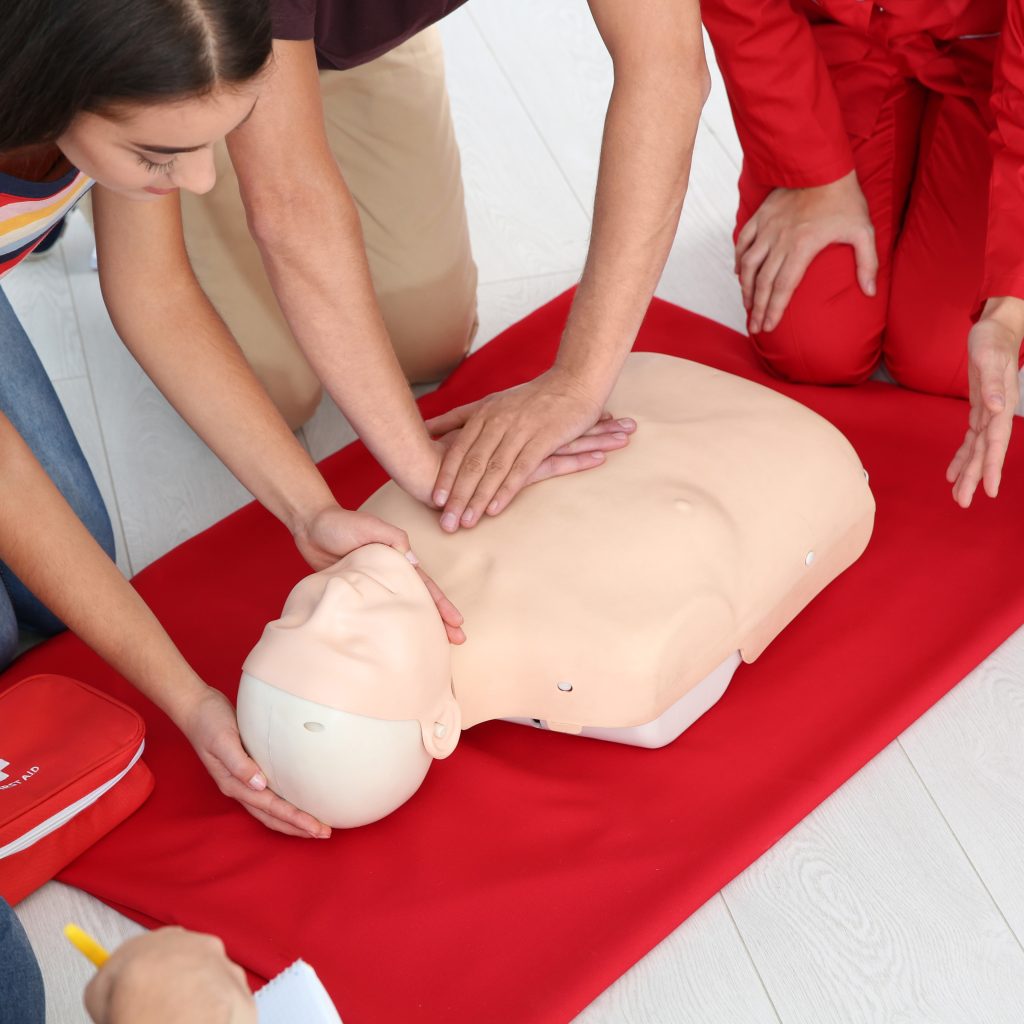
A certified AHA instructor teaches both the theory and the hands-on skills in a single classroom. You practice CPR on manikins, get feedback on your technique from the instructor, and pass a live skills test before your card is issued.
- Time commitment: 4–8 hours depending on course level
- Card issued: Same day
- AHA-compliant: Yes
- Accepted everywhere: Yes
2. Blended / HeartCode (Hybrid)
You complete the theory portion online at your own pace, typically 2 to 5 hours, and then schedule a short in-person skills session, usually 30 to 90 minutes, at an AHA Authorized Training Center. The American Heart Association formally calls this the HeartCode format. It is the fastest-growing option because it gives you flexibility without skipping the hands-on requirement.
Students completing blended CPR training can learn what happens during a CPR skills check and why the hands-on portion is required before completing certain HeartCode certifications.
- Time commitment: ~3–6 hours total, split across two sessions
- Card issued: Upon passing in-person skills check
- AHA-compliant: Yes
- Accepted everywhere: Yes
3. Fully Online (No Skills Check)
Theory and testing are completed entirely online, with no in-person component. Some providers issue a certificate once you pass the online exam. It is fast, it is cheap, and for a lot of jobs it is perfectly fine. The problem is when people use it for roles that require something more.
- Time commitment: 1–3 hours
- Card issued: Digitally, immediately
- AHA-compliant: No
- Accepted for clinical roles: No
Some providers advertise “AHA-based” or “following AHA guidelines” for fully online courses. That is not the same as being AHA-certified.
Side-by-Side Comparison
| Factor | Fully In-Person | Blended (HeartCode) | Online-Only |
| AHA Provider Card | ✅ Yes | ✅ Yes | ❌ No |
| Hospital Accepted | ✅ Yes | ✅ Yes | ❌ No |
| OSHA Compliant (healthcare) | ✅ Yes | ✅ Yes | ❌ No |
| Hands-On Practice | ✅ Full session | ✅ Skills check | ❌ None |
| Real-Time Instructor Feedback | ✅ Yes | ✅ Yes | ❌ No |
| Scheduling Flexibility | ⚠️ Fixed class times | ✅ Online + 1 visit | ✅ Anytime |
| Time to Complete | 4–8 hours | 3–6 hours | 1–3 hours |
| Average Cost | $50–$100 | $40–$80 | $10–$30 |
| Same-Day Certification | ✅ Yes | ✅ Yes | ✅ Yes |
| Non-Clinical Workplaces | ✅ Yes | ✅ Yes | ✅ Often |
| Best For | First-timers, clinical roles | Busy professionals, renewals | General public, low-risk jobs |
Who Accepts What: By Profession
This is the question that articles on this topic rarely answer specifically. Here is the breakdown by role.
- Nurses (RN, LPN, NP, CNA)
Required format: Blended or in-person
Minimum certification: BLS Provider (AHA or ARC)
Additional requirements by unit:
- Med-Surg, ICU, ER: BLS + ACLS
- Pediatric units, PICUs: BLS + PALS
- Labor & Delivery: BLS + NRP (Neonatal Resuscitation Program)
Online-only certificates will not pass hospital onboarding. Major health systems require an AHA eCard with a verifiable certificate ID. If you’re a nurse preparing for clinical work in Maryland, our BLS for nurses guide walks through exactly what you need before your first shift.
- EMTs and Paramedics
Required format: In-person (state EMS agencies require documented hands-on competency)
Minimum certification: BLS (EMT) / BLS + ACLS (Paramedic)
NREMT and most state EMS agencies specifically reject fully online certifications for licensure.
- Dental Hygienists and Dentists
Required format: Blended or in-person
Minimum certification: BLS Provider
Most state dental boards have adopted AHA BLS as the standard. Pediatric dentistry practices often also require PALS.
- Medical and Nursing Students (Clinicals)
Required format: In-person or blended. Required before the first clinical rotation.
Minimum certification: BLS Provider
Many programs will remove students from rotations for lapsed or unaccepted credentials. This applies to nursing, medical, physical therapy, and dental programs.
- Physical Therapists and Occupational Therapists
Required format: Blended or in-person
Minimum certification: BLS Provider
Most hospital and clinic employers require AHA BLS, though APTA does not set a single universal standard.
- Teachers, Coaches, and Childcare Workers
Required format: Varies by state. Online-only is often accepted.
Always verify with your state licensing agency before enrolling, as childcare licensing requirements differ significantly by state.
- Corporate / Office Employees
Required format: Online-only is typically acceptable for general industry compliance
OSHA recommends but does not universally require CPR training for low-hazard industries, and format requirements are more flexible.
- Personal Trainers and Fitness Professionals
Required format: Blended or in-person preferred
Major certification bodies (NASM, ACE, NSCA) require a hands-on skills component. Fully online certificates are not accepted for primary personal training certification.
The Employer Acceptance Problem
Picture this. You complete a 2-hour online CPR course, download your certificate, and walk into your first day at a new hospital job feeling prepared. HR takes one look at your card and asks for the AHA eCard number. You do not have one. Your certificate is not in the AHA system because it was never issued by an AHA Authorized Training Center. You are not certified in any way your employer recognizes.
This is not rare. It happens to nurses, dental hygienists, and nursing students every week. And it is entirely avoidable once you know what employers actually check.
Major health systems do not just take your word for it. They verify your AHA eCard through the AHA portal. The card has a unique certificate ID and a QR code that HR scans on the spot. If that ID returns no results, your certificate does not count. It does not matter how long the course was, who made it, or what the website said about being “AHA-aligned.”
The AHA eCard is the standard. If your card does not have a verifiable ID, it will not be accepted for clinical roles.
Employers and workers who need help selecting the right workplace credential can read our guide to CPR training for employees before choosing an online, blended, or instructor-led course.
Why Hands-On Training Matters
Some people push back on the hands-on requirement. They argue that watching a video teaches the same thing. The research says otherwise.
Compression depth, rate, and chest recoil are the three factors most closely tied to survival in cardiac arrest. All three get worse without physical practice and real feedback from an instructor. Studies have shown that CPR skill quality drops to unacceptable levels within 3 to 6 months for people who trained only through video, compared to 12 or more months for those who practiced on a manikin.
The stakes are real. According to the American Heart Association’s CPR Facts and Stats, immediate CPR can double or triple a cardiac arrest victim’s chances of survival. Yet only about 40% of people who experience cardiac arrest outside a hospital receive bystander CPR before emergency services arrive.
Knowing the steps is not the same as having the physical skill to perform correct compressions at 100 to 120 per minute, at the right depth, while managing an airway and working with a team. That only comes from practicing on a manikin with an instructor watching and correcting in real time.
What OSHA Actually Says About Online-Only CPR
Many people assume OSHA simply requires “some form of CPR training” and that online qualifies. That is only partially true.
OSHA’s formal interpretation letter, issued in response to a direct industry question, states clearly: “Online training alone would not meet the requirements of these training standards.” The agency explains that CPR involves physical skills that can only be learned by actually practicing them, and that a qualified trainer must verify skill performance. This applies to standards covering logging, confined spaces, electric power work, and similar environments.
OSHA’s guidance on workplace first aid programs also specifically recommends that CPR training include hands-on practice using mannequins and partner demonstration.
If you work in a healthcare or safety-critical role, the intent of OSHA’s standard is hands-on competency, not just knowledge of the steps.
Online CPR Has Real Uses Too
To be clear: online-only CPR is not a scam. It genuinely works for the right situations.
It is a good fit for general public skill-building, non-clinical workplace compliance in low-risk settings, refreshing your knowledge between renewals, or learning the basics before attending a formal class. If you work in an office and your employer just wants staff to have some CPR knowledge, online-only probably checks that box.
The issue is using it to satisfy requirements that specifically need a hands-on skills check. That single mismatch is what causes the problems this article is trying to prevent.
BLS vs. ACLS vs. PALS: Format Requirements by Certification Type
| Certification | Online-Only Accepted? | Blended Accepted? | In-Person Accepted? | Valid For |
| BLS Provider | ❌ No | ✅ Yes | ✅ Yes | 2 years |
| ACLS Provider | ❌ No | ✅ Yes | ✅ Yes | 2 years |
| PALS Provider | ❌ No | ✅ Yes | ✅ Yes | 2 years |
| Heartsaver CPR/AED | ✅ Sometimes | ✅ Yes | ✅ Yes | 2 years |
| CPR/AED (basic, non-clinical) | ✅ Often | ✅ Yes | ✅ Yes | 2 years |
BLS must stay current for ACLS and PALS renewals. A lapsed BLS card will block renewal of both advanced certifications at most facilities. This is the most common credentialing problem healthcare providers run into. BLS, ACLS, and PALS each have separate expiration dates and do not renew together automatically.
The Blended Format: Why It Works Best for Most Healthcare Workers in 2026
For healthcare professionals with busy schedules, the blended HeartCode format is usually the best answer when comparing in person vs online CPR certification.
For initial certification, you complete 2 to 5 hours of online modules at home at your own pace, then attend a 30 to 60 minute in-person skills check at an AHA Authorized Training Center. You leave with an official AHA eCard the same day.
For renewal, the in-person session is typically 30 to 45 minutes. HeartCode also does not separate “initial” and “renewal” as different courses. You complete the same steps either way. This is different from traditional instructor-led courses, which have separate and longer initial formats.
Blended courses typically cost between $40 and $80, which is less than a fully in-person class and far more useful than an online-only course that your employer will reject.
What Happens If Your Certification Lapses?
There is no grace period. The moment your BLS, ACLS, or PALS card expires, you are no longer certified.
Most healthcare employers will remove you from patient care duties right away. The consequences range from unpaid suspension to requiring a full initial course, which is significantly longer and more expensive than a renewal.
If your card has already expired: Take the full initial provider course. For BLS, that means about 4 to 5 hours. For ACLS or PALS, plan for a full day or more. If you are more than 30 days lapsed, most facilities will not allow the shorter renewal option.
Best practice: Schedule your renewal 60 to 90 days before your eCard expiration date. If your BLS, ACLS, and PALS all expire around the same time, take them together in one visit. It saves time and often reduces the cost.
How to Spot a Legitimate CPR Certification Provider
Not every provider that shows up in a Google search is an AHA Authorized Training Center. Some sell certificates that look real but will not pass employer verification. Here is what to look for before you pay.
Look for:
- Listed as an AHA Authorized Training Center like Comfi-Kare CPR in Maryland.
- Issues AHA eCards with unique, verifiable certificate IDs
- Requires an in-person skills check for all provider-level courses
- AHA-certified instructor whose credentials are available on request
Red flags:
- “100% online” BLS, ACLS, or PALS without a skills component
- Skills session described as optional or separate from certification
- Certificate cannot be verified on the AHA portal
- “AHA-based” or “AHA-aligned” language rather than “AHA-issued”
- No QR code or certificate ID on the card
That last language point is worth paying attention to. “Based on AHA guidelines” is not the same as “AHA-certified.” Providers use that phrase because they cannot legally claim the other one.
5 Questions to Ask Before You Enroll
- Does my employer require an AHA Provider card specifically? Call HR before registering, not after.
- Does this course include a hands-on skills component?
- Is this provider an AHA Authorized Training Center?
- Will I receive an AHA eCard with a verifiable certificate ID?
- Is my current card still valid? If lapsed, you may need the full initial course rather than the renewal.
Ready to Get Certified in Maryland?
If you have read this far, you already know more about CPR certification formats than most people do when they register for a class. Now the next step is simple: pick a date and show up.
At Comfi-Kare CPR, we are an AHA Authorized Training Center. That means every card we issue is a real AHA eCard with a verifiable certificate ID, accepted by hospitals, clinics, and licensing boards across Maryland. We offer fully in-person instructor-led classes and the HeartCode blended format, so you can choose what fits your schedule without worrying about whether your employer will accept it.
We serve Frederick, Gaithersburg, Germantown, Rockville, Silver Spring, Bethesda, and surrounding areas. Classes run regularly, seats fill up, and you leave the same day with your card in hand.
Not sure which course is right for your role? Contact us and we will point you in the right direction before you register. No pressure, just a straight answer.
Conclusion
The difference between in person vs online CPR certification comes down to one thing: whether your employer can verify your card. For healthcare professionals, the answer is clear. A fully online certificate will not pass AHA portal verification, will not satisfy OSHA requirements for safety-critical roles, and will not get you through hospital onboarding. You need either a fully in-person class or the blended HeartCode format, both of which result in an official AHA eCard that is accepted everywhere it needs to be.
If you are based in Maryland and ready to get certified or renewed, Comfi-Kare CPR offers AHA-compliant BLS, ACLS, and PALS courses with flexible scheduling and same-day cards. Call us at 240-676-4239 and we will help you choose the right course for your role before you register.
Frequently Asked Questions about In-person vs Online CPR Certification
Is online CPR certification accepted by hospitals?
No. Fully online CPR certifications without a hands-on skills check are not accepted by hospitals for clinical roles. Hospitals require an AHA eCard, which is only issued through courses that include an in-person skills evaluation. This means either a full instructor-led class or the blended HeartCode format.
What is the difference between online CPR and BLS certification?
BLS (Basic Life Support) is the professional-level certification required for healthcare workers. It covers CPR plus team-based response, bag-mask ventilation, and clinical scenarios. While the theory portion can be completed online through HeartCode, a BLS Provider card still requires a hands-on skills check. A fully online certificate is not the same as a BLS Provider card.
What is HeartCode BLS?
HeartCode BLS is the American Heart Association’s official blended learning format for BLS certification. You complete the theory content online at your own pace, then attend a short in-person skills session with an AHA-certified instructor. The AHA eCard you receive is identical in validity and employer acceptance to one earned through a fully in-person class.
Can I do ACLS or PALS online?
The theory portion of ACLS and PALS can be completed online through HeartCode. However, the in-person skills check is required. There is no path to an AHA ACLS or PALS Provider card without a hands-on evaluation. Fully online ACLS or PALS certificates are not accepted by hospitals.
How long does a blended CPR certification take?
The blended HeartCode format typically takes 3 to 6 hours total: 2 to 5 hours for the online portion at your own pace, plus a 30 to 90 minute in-person skills session. Most people complete the online modules over 1 or 2 days and schedule the skills check when it fits their schedule.
Is a blended CPR certification the same as fully in-person for employer purposes?
Yes. Both result in an official AHA Provider eCard with the same two-year validity and the same QR code verification. The difference is learning format and time commitment, not the credential itself.
Does OSHA require a specific CPR format?
OSHA does not require a single provider for general industry. However, for roles subject to specific OSHA standards such as logging, confined spaces, and electric power work, hands-on skills verification is required. OSHA has formally stated that online-only training does not meet the requirements of those standards.
What happens if my BLS certification expires?
Once expired, you are no longer certified. There is no grace period. Most healthcare employers remove providers from patient care duties right away. You will typically need the full initial course rather than the shorter renewal version. Renew 60 to 90 days before your eCard expiration to avoid any disruption.
Can I do just a skills session if I already completed the HeartCode online modules?
Yes. Many AHA Authorized Training Centers offer skills-only sessions for providers who completed the HeartCode online portion independently. Contact your local training center to confirm they accept self-enrolled HeartCode completions before booking.
Which is better for renewal, in-person or blended?
For most working healthcare professionals, blended is the more practical choice. It requires only a 30 to 45 minute in-person session compared to 4 or more hours for a full class, and the resulting AHA eCard is identical. It is faster, often cheaper, and equally accepted.
Our guide to choosing between online and in-person CPR training explains the differences in more detail.