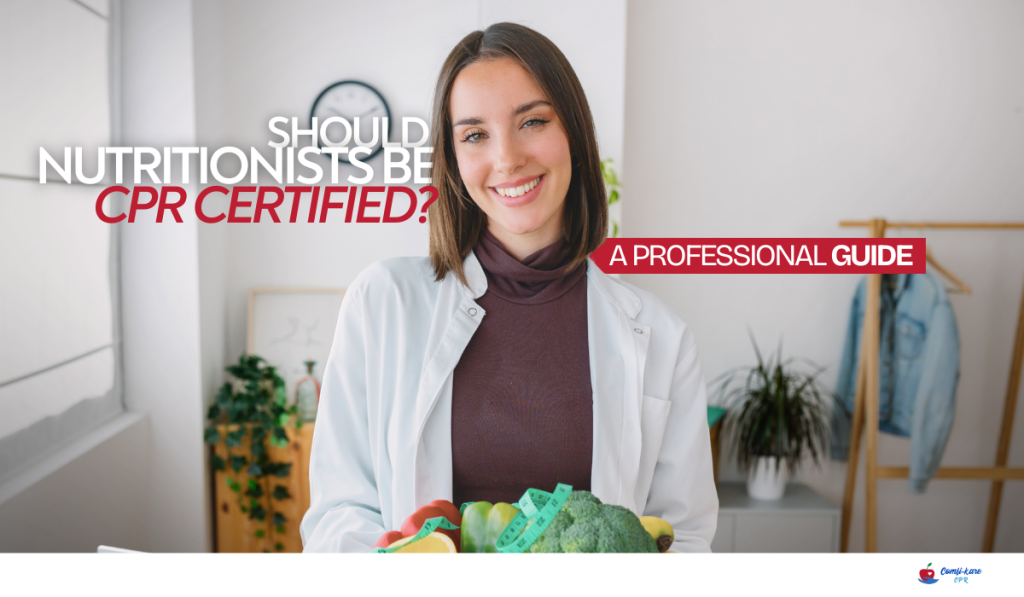
CPR for nutritionists is not optional — it is a professional baseline. As a dietitian or nutrition practitioner, you work every day with clients who have food allergies, diabetes, and heart conditions. Any of these can turn into a life-threatening emergency in your office.
This guide explains what can go wrong, what CPR certification covers, and why it matters for your career.
Key Takeaways
- Nutritionists regularly see clients at risk of cardiac arrest, anaphylaxis, and choking
- Most clinical, school, and hospital employers require CPR AED certification
- Food emergencies can turn fatal in under 5 minutes — your response time matters
- AHA Heartsaver CPR/First Aid takes a few hours and is valid for two years

Should Nutritionists Get CPR Certified? The Short Answer
Yes. The Academy of Nutrition and Dietetics (AND) does not require it by law — but that does not mean you are not at risk. It just means the rules have not caught up with reality yet.
Think about where you work: private offices, hospital clinics, gyms, schools, corporate wellness centers, home visits. In most of these places, you may be the only health professional in the room when something goes wrong.
Many employers already require CPR AED certification as a condition of hire. If you work in private practice, it is also one of the smartest liability decisions you can make.
Which Clients Put Nutritionists at Risk?
Not all jobs carry the same emergency risk. Nutritionists do — because of who they work with. Here are the client groups most likely to have a medical emergency in your presence:
- Clients with food allergies
Around 33 million Americans have a food allergy, according to Food Allergy Research & Education (FARE). About 200,000 end up in the ER every year because of it. The worst reaction — anaphylaxis — can lead to cardiac arrest in as little as 5 minutes if the person does not get epinephrine. If you run food reintroduction sessions or elimination diet consultations, you are in the room when this risk peaks.
- Clients with diabetes
Type 1 and type 2 diabetics can drop their blood sugar dangerously fast. When it gets too low, they can lose consciousness, have a seizure, or go into cardiac arrest. The American Diabetes Association estimates insulin-dependent patients have 1.5 to 2 severe hypoglycemic episodes per year. If you have 20+ diabetic clients, a serious episode during a session is not a question of if — it is when.
- Bariatric and post-surgery clients
People who have had weight loss surgery are often deficient in key nutrients like potassium and magnesium. These deficiencies can cause dangerous heart rhythms. Nutritionists in bariatric support roles need to be ready.
- Older adults on cardiac or renal diets
Older clients with heart disease or kidney conditions are at high risk of sudden cardiac arrest. In this group, fast bystander CPR has the biggest impact on survival.
- Fitness and performance clients
Even healthy, fit clients can have a cardiac event during exercise. Hypertrophic cardiomyopathy — a heart condition that causes sudden death in young athletes — often goes undiagnosed. If you work in a gym or fitness setting and someone collapses, you are the first responder by default.
Food-Related Emergencies That Require CPR or First Aid
These are the four most common emergencies nutritionists face — and where your training makes the difference:
- Anaphylaxis — severe allergic reaction
Anaphylaxis can stop the heart. It moves fast. When a client loses consciousness and stops breathing, you need to act immediately. First aid certification teaches you to: spot the signs early, help them use their EpiPen, position them correctly, and start CPR if they stop breathing. Every minute counts.
- Choking on food
Food is the leading cause of choking deaths in the U.S. The CDC estimates around 5,000 people die from choking every year. The risk is higher when you do food tastings, work with older clients who have swallowing problems, or run cooking demos.
CPR and first aid training teaches you the full response: back blows and the Heimlich maneuver for adults, a different technique for infants, and — most importantly — what to do when the person loses consciousness. Most untrained bystanders freeze at that moment. You will not.
- Diabetic collapse
When blood sugar crashes to a critical low, a client can go from confused to unconscious in minutes. If they are still conscious, fast-acting carbs help. If they are not — you need CPR. Hypoglycemia can also trigger a dangerous heart rhythm, making CPR the difference between life and death.
- Cardiac arrest during a consultation
A client with heart disease sitting in your office is already at risk. Stress, physical activity, or even the conversation itself can trigger a cardiac event. According to the American Heart Association, survival chances drop 7–10% for every minute without defibrillation. An AED used within 3–5 minutes gives them the best shot at survival.
What Does CPR AED Certification Cover?
The right course for most nutritionists is the AHA Heartsaver CPR/AED with First Aid. It is built for non-clinical professionals — no medical background needed. Here is what it teaches:
- CPR for adults, children, and infants
You learn how to perform chest compressions and rescue breaths correctly for each age group. The current AHA guidelines call for 100–120 compressions per minute, at least 2 inches deep for adults. These guidelines change — if your certification is more than 2 years old, you may be out of date.
- AED operation
AEDs are in most gyms, offices, and schools. The device talks you through every step — but you need training to use it without hesitation. The course covers how to turn it on, place the pads, and coordinate CPR and AED together. Most people who skip training are too afraid to use it. That hesitation costs lives.
- Choking relief for all ages
Back blows and the Heimlich maneuver for adults and children. Different technique for infants. And the critical transition to CPR when someone stops responding.
- Allergy emergencies
First aid training covers how to recognize anaphylaxis, help a client use an EpiPen, and what to do while waiting for EMS. Important: epinephrine buys time — it is not a substitute for calling 911.
- Other first aid skills you will use
- Stroke recognition — using the FAST method (Face, Arms, Speech, Time)
- Responding to fainting and seizures
- Managing low blood sugar in conscious clients
- Wound care and bleeding control for cooking/food prep settings
How Long Does CPR Certification Last?
AHA Heartsaver certifications are valid for 2 years. You need to renew before the card expires — not after. Most employers will not accept an expired card.
The 2-year cycle exists because guidelines change. The ILCOR and the AHA regularly update CPR protocols. Recertification keeps you current and usually takes just 2–3 hours.
Most nutrition jobs accept the Heartsaver course. Some clinical employers require BLS for Healthcare Providers instead — check with your HR team before booking.
Why CPR Certification Is Good for Your Career
- More job opportunities
Hospitals, schools, and wellness centers often screen out candidates who are not CPR certified — before the interview stage. A current card removes that barrier.
- Access to better roles
CPR certification opens doors to hospital outpatient departments, residential care, community clinics, and school districts that would otherwise be off-limits.
- Legal protection
Some states require licensed health professionals to respond to emergencies they witness. If you do not — or if your certification is lapsed — you may face liability. A current certification protects you.
- Client confidence
Clients with food allergies, diabetes, or cardiac conditions notice when a practitioner takes safety seriously. It is a real differentiator for private practices.
What to Do in a Food-Related Emergency: Quick Reference
This is not a substitute for real training. But here is what the response looks like for the three most common scenarios:
If a client shows signs of anaphylaxis
- Call 911 immediately — do not wait
- Ask if they have an EpiPen. If yes, help them use it — outer thigh, through clothing
- Lay them flat, legs elevated — unless they are struggling to breathe, then sit them up
- Do not give food, water, or antihistamines — they do not treat anaphylaxis
- If they lose consciousness and stop breathing: start CPR — 30 compressions, 2 breaths — and get the AED
- Keep going until EMS arrives
If a client is choking
- Ask: “Are you choking?” If they can cough or speak, let them cough — do not intervene yet
- If they cannot breathe or speak: stand behind them, give 5 firm back blows between the shoulder blades
- Follow with 5 abdominal thrusts: fist above the navel, sharp inward-upward push
- Keep alternating until the obstruction clears or they lose consciousness
- If they collapse: lower them to the floor, call 911, start CPR — check the mouth before each breath
If a diabetic client collapses
- Call 911 immediately
- Do not give food or liquid — they can choke on it
- If they are breathing, turn them on their side (recovery position)
- If they stop breathing, start CPR
- Tell EMS the client is diabetic — it changes their treatment
Conclusion
CPR for nutritionists is a simple decision with a big impact. Your clients — people with food allergies, diabetes, heart conditions — are at real risk every time they sit down with you. A two-hour certification every two years is all it takes to be the person who can actually help when something goes wrong.
The standard of care is changing. Employers expect it. Clients benefit from it. If your certification has lapsed — or you have never trained — now is the time.
Ready to get certified? Comfikare CPR offers AHA-aligned CPR and First Aid courses across Maryland — Frederick, Rockville, Silver Spring, Gaithersburg, and more. Contact us or call 240-676-4239 to schedule your class.
Frequently Asked Questions About CPR for Nutritionists
Do nutritionists need CPR certification?
Most state licensing boards do not require it. But most employers do — especially hospitals, clinics, schools, and long-term care facilities. Beyond that, you work with clients who can have a cardiac emergency at any time. Having current CPR for nutritionists certification is professional best practice, regardless of the law.
What is the best CPR certification for a nutritionist?
The Comfi-Kare CPR/AED with First Aid course is the right fit for most nutritionists and dietitians. It covers adult, child, and infant CPR, AED use, choking, and first aid including allergy and diabetic emergencies. No clinical background needed. If you work in a hospital, your employer may require BLS for Healthcare Providers instead — check before you enroll.
How long does CPR certification last?
Two years. Renew before it expires. Most renewal courses take 2–3 hours and keep you current with the latest AHA guidelines.
What food emergencies need CPR?
Three main ones: severe anaphylaxis (which can stop the heart), choking (which requires CPR once the person loses consciousness), and severe diabetic collapse (which can cause dangerous heart rhythms). CPR for food emergencies is not a specialty — it is standard CPR in a context nutritionists face more than most people.
Can a nutritionist legally perform CPR?
Yes. CPR is not a clinical procedure — it is a basic life skill anyone can perform. Most states have Good Samaritan laws that protect people who respond in good faith. Performing CPR as a nutritionist is not practicing medicine. It is saving a life.
Is CPR required for registered dietitians (RDs)?
The Commission on Dietetic Registration (CDR) does not require it for the credential. But many workplaces do. Clinical RDs may also need BLS for Healthcare Providers rather than the standard Heartsaver course.
Where can nutritionists get CPR classes in Maryland?
Comfikare CPR offers AHA-aligned courses across Maryland — Frederick, Rockville, Silver Spring, Gaithersburg, Bethesda, Columbia, and more. Classes are taught by certified instructors and can come to your workplace. Contact Comfikare CPR at comfikarecpr.com/contact-us to book.
How much does CPR certification cost?
In-person AHA Heartsaver courses typically cost $50–$100. Group rates are available for practices certifying multiple staff. Most employers treat it as a reimbursable professional development expense.