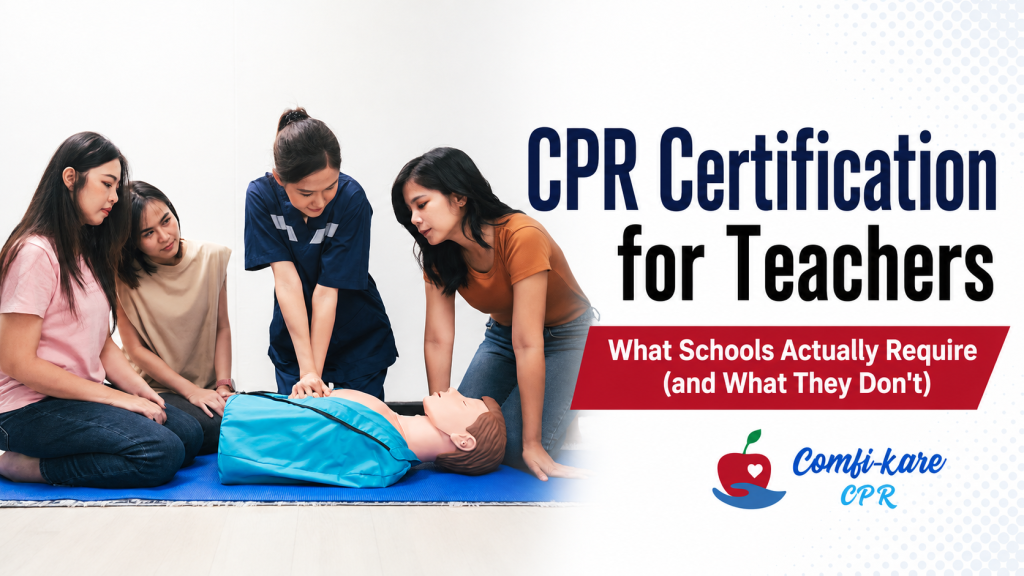
Ask five teachers if they’re required to be CPR certified and you’ll probably get five different answers. Some think it’s mandatory for every classroom teacher. Some think it only applies to gym teachers and coaches. Some have no idea, because nobody at their school ever explained it clearly.
Here’s the part that surprises most people: in a lot of cases, the law doesn’t require every individual teacher to be certified. It requires the school to have enough certified staff and the right equipment on hand. That distinction changes how you should think about CPR certification for teachers, and it’s exactly what this guide breaks down.
Key Takeaways
- Most laws require schools to have CPR-trained staff coverage, not every teacher personally certified.
- Teachers usually need Heartsaver-level CPR and AED training, not the healthcare-provider BLS card.
- CPR-in-schools laws often teach students CPR. That’s a separate rule from staff certification.
- Coaches usually face stricter, separate CPR rules through athletic associations.

What Does CPR Certification for Teachers Actually Mean?
There are two levels of CPR training, and knowing which one applies to you matters.
Healthcare providers, like nurses and medical assistants, need BLS Provider certification, a more advanced course built for clinical teams. Teachers almost always need the other level: Heartsaver CPR and AED, built for laypeople who might need to respond in a classroom or hallway, not a hospital.
If you’ve looked into CPR certification for medical assistants, you’ve probably seen how strict the card-type rules are in healthcare settings. For teachers, the requirement is simpler. Heartsaver CPR and AED is the right course for almost every school role, and it’s shorter and less expensive than the healthcare-provider version.
Do All Teachers Need to Be CPR Certified? The Requirement Most People Get Wrong
This is the myth worth clearing up first.
Most state and local rules don’t say “every teacher must be personally certified.” They say something closer to “the school must have adequate CPR-trained staff coverage and a working AED on site.” Those are different requirements, and the second one is far more common.
In practice, this plays out through a few overlapping layers:
- State and local school safety laws. Many states require schools to maintain AEDs and keep enough CPR-trained staff on hand during school hours, an approach the CDC’s Healthy Schools program tracks as part of overall school health and safety planning.
- District policy. Individual school districts often go further than state minimums, requiring CPR training for specific roles like recess and cafeteria monitors, front office staff, or bus drivers.
- Building-level decisions. A principal may require broader staff coverage than either the state or the district mandates, especially in a school without a full-time nurse on site every day.
The result is that most teachers end up certified anyway, often through school-organized training, even though the law itself may not name them individually.
CPR in Schools Laws: Student Requirement vs. Staff Requirement
These two things get confused constantly, and they’re not the same law.
| Student CPR Education | Staff CPR Certification | |
|---|---|---|
| What it requires | Students learn CPR basics as part of health class | Certain staff hold a current, verified CPR card |
| Goal | Graduation requirement, general public readiness | Emergency response readiness during school hours |
| Who it applies to | High school students, in many states | Designated staff, not necessarily every teacher |
| How it’s fulfilled | In-class instruction, often without a formal card issued | A certified course with an in-person skills check |
Maryland is among the states that have built CPR instruction into health education requirements for students. That’s a separate track from the question of which staff members personally need a certification card, and mixing the two up is one of the most common sources of confusion for new teachers.
What a CPR Course for Teachers Should Include
- CPR technique for children and adults, since a classroom or hallway can involve either
- AED use, including where the device is kept in the building
- Choking response, especially relevant for elementary and cafeteria settings
- Recognizing a medical emergency versus a behavioral or medical episode that doesn’t require CPR
- Anaphylaxis and EpiPen training, often bundled into the same course
That last point is worth calling out. Schools frequently pair CPR and AED training with epinephrine auto-injector training in a single course, since food allergy reactions are one of the more common medical emergencies teachers actually encounter. The CDC’s guidelines for managing food allergies in schools reflect how common this pairing has become in school emergency planning.
CPR Certification for Coaches and After-School Staff
Coaching adds a layer most classroom teachers never deal with.
Many state high school athletic associations require coaches to hold current CPR and AED certification, separate from whatever their home school district requires for classroom staff. This isn’t optional in most athletic programs, and it often needs to be renewed on a tighter schedule than a standard teaching role.
If you coach in addition to teaching, it’s worth checking with your athletic director directly. The requirement can be stricter than what applies to you as a classroom teacher.
Why Schools Usually Schedule CPR Training as a Group, Not Individually
Very few teachers sign up for a CPR class on their own. Most get certified because the school scheduled it.
Back-to-school professional development days are the most common window for this. A school or district books a single group session, certifies an entire staff or grade level at once, and folds the cost and time into a day that was already planned.
This matters if you’re a school administrator reading this instead of a teacher. Group and on-site training is almost always more efficient than sending staff out individually, and it’s the approach most Maryland schools already use.
How Long Does It Last, and Who Tracks Renewal?
Heartsaver CPR and AED certification is typically valid for two years, the same cycle used across most CPR training levels.
The harder question is who actually tracks that date. In some schools, HR or the front office keeps a master list and reminds staff before cards expire. In others, it falls on the individual teacher to remember, and it’s easy to lose track over a summer break.
If your school doesn’t have a tracking system, setting your own calendar reminder is the simplest fix.
Substitute Teachers and Paraprofessionals
The same overlapping rules that apply to full-time teachers usually apply here too, sometimes with less consistency.
Substitute teachers are often held to a lower bar, since they may not be alone with students for extended periods the way a homeroom teacher is. Paraprofessionals, especially those working one-on-one with students who have medical needs, are frequently required to hold current CPR certification even where classroom teachers in the same building aren’t.
The safest approach for both roles is the same: ask the school directly rather than assuming the classroom teacher requirement applies equally.
How to Get CPR Certified as a Teacher in Maryland
- Check with your school or district first. Some specify Heartsaver CPR and AED specifically, or add EpiPen training as a requirement.
- Choose a course built for school staff, not a healthcare-provider level course, unless your role specifically calls for it.
- Complete the in-person skills check. This applies at every certification level, including Heartsaver.
- Get your card, typically issued the same day.
- Set a renewal reminder two years out, especially if your school doesn’t track this centrally.
Comfi-Kare CPR runs Heartsaver CPR, AED, and EpiPen training across Maryland, including on-site group sessions built for back-to-school professional development days.
Common Mistakes Teachers and Schools Make With CPR Certification
- Assuming every teacher is legally required to be certified, when the actual requirement often applies to the school’s overall coverage
- Enrolling in a healthcare-provider BLS course when Heartsaver CPR and AED is what the role actually needs
- Confusing student CPR education requirements with staff certification requirements
- Letting a card lapse over summer break with no reminder system in place
- Assuming coaching and classroom teaching carry the same CPR requirements
Conclusion
CPR certification for teachers isn’t a single, simple rule. It’s a mix of school-level coverage requirements, district policy, and role-specific rules for coaches and paraprofessionals, layered with a separate set of laws about what students learn in health class.
Comfi-Kare CPR trains teachers, coaches, and school staff across Maryland, with both individual and group options built around how schools actually schedule this training. If your school needs to book a session, contact Comfi-Kare CPR to get started. We’ve also covered CPR requirements for other roles, including home health aides and lifeguards, if you’re researching certification for a different job.
Frequently Asked Questions about CPR Certification for Teachers
Do teachers need CPR certification?
Not always as an individual legal requirement. Most rules require the school to maintain adequate CPR-trained staff coverage and a working AED, which often results in many or most teachers being certified anyway.
What type of CPR certification do teachers need?
Heartsaver CPR and AED certification, built for laypeople, not the healthcare-provider BLS level required for clinical roles.
Is CPR training for students the same as CPR certification for staff?
No. Many states, including Maryland, require students to learn CPR as part of health education. That’s separate from the rules about which staff members need a certification card.
Do coaches need different CPR certification than classroom teachers?
Often yes. Many athletic associations require coaches to hold current CPR and AED certification, sometimes on a stricter renewal schedule than classroom staff.
How long does CPR certification last for teachers?
Typically two years, though it’s worth confirming who at your school tracks renewal dates.
Can schools book CPR training for an entire staff at once?
Yes, and it’s the most common way teachers actually get certified, usually during back-to-school professional development days.