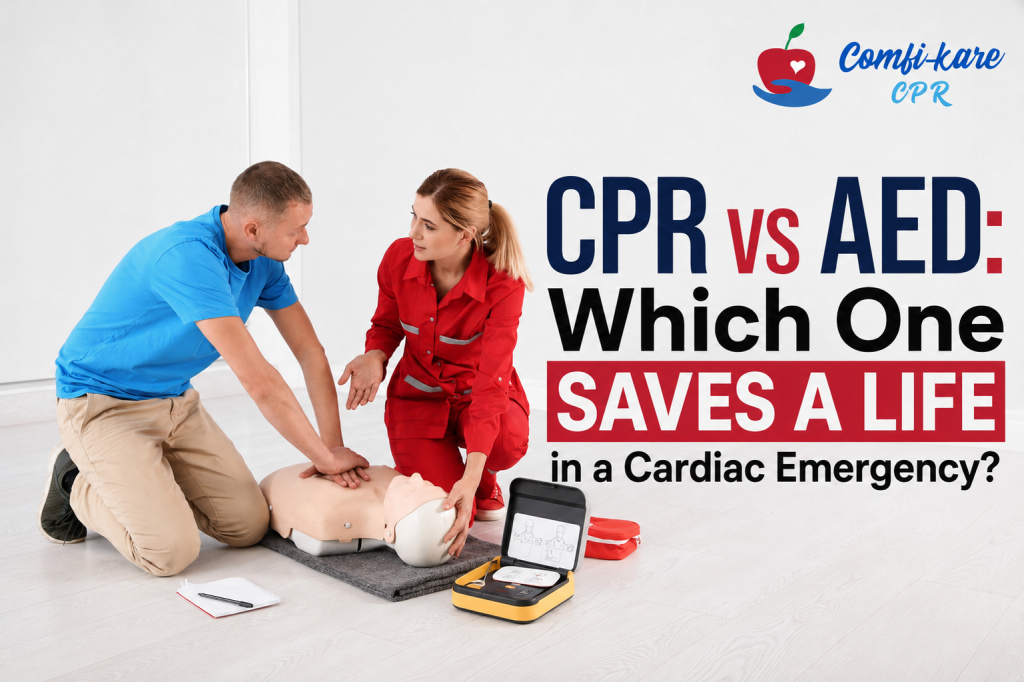
When someone collapses in sudden cardiac arrest, bystanders often freeze on the same question: do I start chest compressions, or do I run for the AED? It feels like a choice between two options — but treating “CPR vs AED” as an either/or decision is one of the most common, and most dangerous, misunderstandings in emergency response.
CPR and an AED (Automated External Defibrillator) aren’t competitors. They’re two parts of the same life-saving sequence, and understanding how they work together — not which one “wins” — is what actually improves a person’s chance of survival.
This guide breaks down exactly what each does, which one comes first, how to use them together in real-world scenarios, the science behind why both matter, and the mistakes that cost precious seconds when it matters most.
Key Takeaways
- CPR and an AED serve different purposes: CPR keeps blood circulating, while an AED restarts a heart’s normal electrical rhythm.
- In nearly every scenario, CPR should begin immediately, and an AED should be applied and used the moment it’s available — not one instead of the other.
- The CDC reports that bystander CPR can double or triple survival rates after cardiac arrest.
- An AED will not shock someone unless a shockable rhythm is detected, making it safe for untrained bystanders to use.
- Every minute without CPR or defibrillation lowers survival odds significantly, which is why acting fast matters more than acting perfectly.
- Good Samaritan laws in most states offer legal protection to bystanders who act in good faith during a cardiac emergency.
What Is CPR? A Closer Look
CPR (Cardiopulmonary Resuscitation) is a manual technique combining chest compressions — and in some protocols, rescue breaths — to keep oxygenated blood circulating to the brain and vital organs when the heart has stopped effectively pumping on its own. CPR does not restart the heart. Its job is to buy time, keeping the brain and organs alive long enough for defibrillation or advanced care to restore a normal heartbeat.
Hands-Only CPR vs Conventional CPR
For untrained bystanders, the American Heart Association recommends Hands-Only CPR — continuous chest compressions without rescue breaths — for adults who collapse suddenly. This removes the hesitation many people feel about performing rescue breaths on a stranger, and studies have shown it’s nearly as effective as conventional CPR for witnessed adult cardiac arrest in the first several minutes.
Conventional CPR, which includes rescue breaths, is still recommended for:
- Infants and children
- Drowning victims
- Cases of drug overdose or respiratory arrest
- Anyone trained and comfortable performing full CPR
Key Elements of Effective CPR
- Compressions at a rate of 100–120 per minute
- Compression depth of at least 2 inches (5 cm) for adults
- Allowing full chest recoil between compressions
- Minimizing pauses in compressions to under 10 seconds
- Switching compressors every two minutes to prevent fatigue-related quality loss
- Placing hands on the center of the chest, one on top of the other
What Is an AED? How It Actually Works
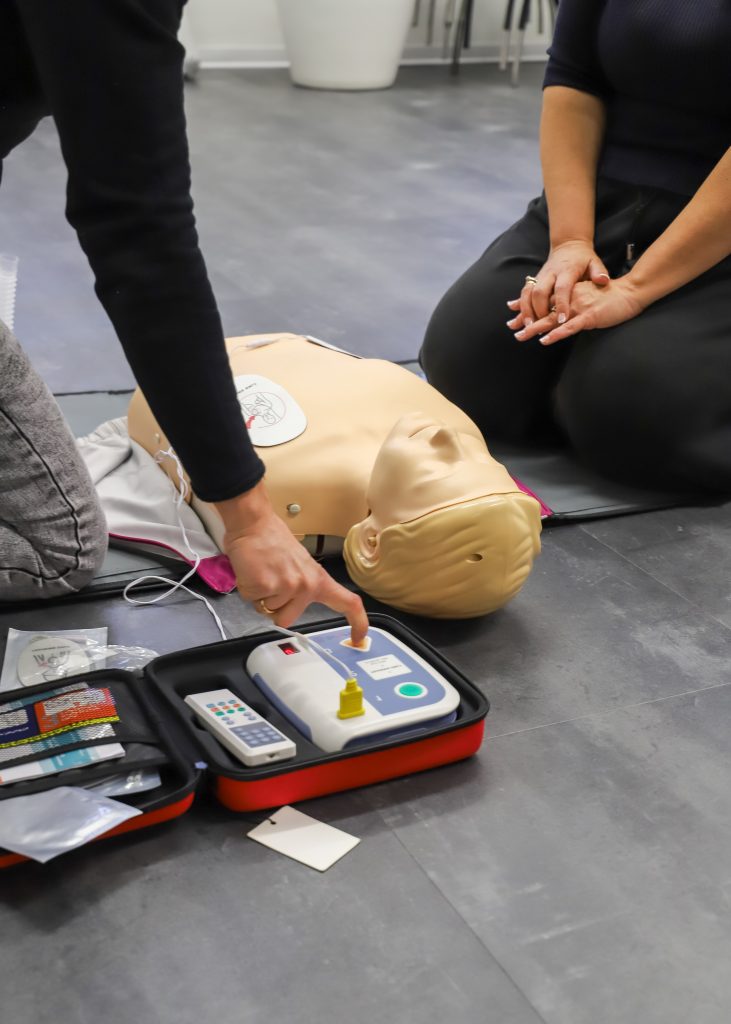
An AED is a portable device that analyzes a person’s heart rhythm and delivers an electric shock if — and only if — it detects a “shockable” rhythm, such as ventricular fibrillation (VF) or pulseless ventricular tachycardia (VT). That shock momentarily stops all electrical activity in the heart, giving it a chance to resume a normal, organized rhythm on its own.
The Technology Behind the Shock
Inside the device, sensors read the electrical signal coming through the pads attached to the person’s chest. A built-in algorithm compares that signal against known shockable and non-shockable rhythm patterns. If the rhythm doesn’t match a shockable pattern — for example, if the heart has already stopped all electrical activity (asystole) — the device will not advise a shock, because defibrillation isn’t effective for that rhythm type. In that case, continued CPR is the correct response.
Where AEDs Are Typically Found
Public access AEDs are increasingly common in:
- Airports and transit stations
- Schools and university campuses
- Gyms and fitness centers
- Office buildings and workplaces
- Shopping malls and stadiums
- Community centers and places of worship
Many are mounted in clearly marked cabinets, sometimes with an audible alarm when opened, and are designed to be usable by anyone nearby — not just staff.
AEDs Are Designed for Anyone
AEDs are built for use by bystanders with no medical training. The device walks the user through each step with voice prompts, analyzes the rhythm automatically, and will not deliver a shock if one isn’t needed — which is why hesitancy to use one due to fear of “doing it wrong” is largely unfounded.
CPR vs AED: Quick Comparison
| CPR | AED | |
| What it does | Manually circulates blood | Analyzes and corrects heart rhythm |
| Who can perform it | Anyone, trained or untrained | Anyone, trained or untrained |
| Restarts the heart? | No | Yes, if a shockable rhythm is present |
| Needed even if the other is used? | Yes, always | Only if a shockable rhythm is detected |
| Risk if used unnecessarily | Very low | None — device won’t shock unless indicated |
| Primary goal | Preserve brain and organ viability | Correct lethal arrhythmia |
CPR vs AED: They’re Not Competing Tools, They’re a Team
This is the single most important concept to understand: CPR and an AED address two different problems.
- CPR treats circulation — it keeps blood moving so organs don’t die from lack of oxygen.
- An AED treats the heart’s electrical rhythm — it’s the only intervention that can actually stop a lethal arrhythmia and give the heart a chance to restart normally.
Neither one substitutes for the other. Compressions alone can sustain someone temporarily, but if their heart is in a shockable rhythm, only defibrillation can correct it. Conversely, a shock without ongoing CPR to support circulation before and after defibrillation is far less effective than the two used together.
According to the American Heart Association, the Chain of Survival for out-of-hospital cardiac arrest explicitly includes both early CPR and early defibrillation as sequential, connected links — not alternative paths.
The Chain of Survival: Where CPR and AED Fit
The AHA’s Chain of Survival frames cardiac arrest response as a sequence of links, each dependent on the one before it:
- Immediate recognition of cardiac arrest and activation of emergency response
- Early CPR, with an emphasis on high-quality chest compressions
- Rapid defibrillation using an AED as soon as one is available
- Basic and advanced emergency medical services
- Advanced life support and post-arrest care
- Recovery, including physical, emotional, and cognitive support
Notice that CPR and defibrillation occupy two separate, sequential links — not competing branches. Breaking or delaying any single link weakens the entire chain, which is why “which one first” is the wrong framing; the real goal is minimizing the gap between both.
Which Comes First — CPR or AED?
In almost every real-world scenario, the answer is: start CPR immediately, and use the AED the moment it’s available — ideally with someone retrieving it while another person begins compressions.
Here’s the general sequence recommended for a witnessed adult cardiac arrest:
- Check responsiveness and breathing. Tap and shout. If the person is unresponsive and not breathing normally, treat it as cardiac arrest.
- Call for emergency help immediately (or have someone else call) and ask someone to bring an AED if one is available.
- Begin chest compressions right away. Don’t wait for the AED to arrive — every second without compressions matters.
- As soon as the AED arrives, turn it on and follow the voice prompts. Attach the pads as instructed, typically to bare skin on the upper right chest and lower left side.
- Let the AED analyze the rhythm. Stop compressions only when the device instructs you to, so it can accurately read the heart’s rhythm.
- If a shock is advised, make sure no one is touching the person, then deliver the shock as instructed.
- Resume CPR immediately after the shock, or immediately if no shock was advised — don’t stop to check for a pulse first.
- Continue cycles of CPR and AED analysis until emergency responders arrive and take over, or the person shows signs of recovery.
The critical takeaway: compressions should almost never stop for longer than necessary, and the AED is layered into that ongoing effort rather than replacing it at any point.
Real-World Scenario Walkthroughs
Training videos rarely match the chaos of a real emergency. Here’s how the CPR-and-AED sequence plays out in situations bystanders actually encounter.
Scenario 1: You’re Alone With the Person, No AED Nearby
Call emergency services first — put your phone on speaker if you’re alone so you can follow dispatcher instructions while acting. Begin CPR immediately and continue until help arrives or an AED becomes available. Don’t leave the person to search for a distant AED unless you’re confident one is within very close reach.
Scenario 2: A Second Person Is Present
Divide roles immediately: one person begins compressions while the other calls 911 and retrieves the nearest AED. Clear, direct instructions (“You — call 911. You — get the AED by the front desk.”) prevent the bystander hesitation that often wastes critical seconds in group settings.
Scenario 3: The AED Arrives Mid-Compressions
Don’t stop compressions to “wait and see.” Keep going while the AED is powered on and pads are applied — most modern devices will explicitly tell you when to pause for rhythm analysis.
Scenario 4: The AED Says “No Shock Advised”
This means the device didn’t detect a shockable rhythm — it does not mean CPR should stop. Continue compressions immediately, exactly as the device instructs.
Scenario 5: In a Workplace or Public Setting
If you’re in a building with a marked AED cabinet, someone should retrieve it the moment cardiac arrest is suspected, even before confirming a diagnosis is certain. Many public AEDs are also linked to building security or facilities teams — alerting them can speed up EMS access to the scene as well.
Scenario 6: You’re Not Sure the Person Is Actually in Cardiac Arrest
Err on the side of starting CPR. Guidance from the AHA is clear that the risk of performing CPR on someone who doesn’t strictly need it is far lower than the risk of withholding it from someone who does.
Do You Still Need CPR If You Have an AED?
Yes — unambiguously. This is one of the most persistent misconceptions bystanders have, likely because AEDs are marketed around the “shock” as the dramatic, life-saving moment. In reality, the shock is only useful if the brain and heart tissue have been kept viable by ongoing circulation — which is CPR’s job.
Even AED manufacturer guidance is explicit that the device is meant to be used alongside CPR, not instead of it. A person can have an AED applied and still need continuous compressions before, between, and after any shocks delivered.
The Science: Why Both Interventions Matter Physiologically
The physiology here explains why the “CPR vs AED” framing is misleading in the first place. During cardiac arrest, the heart’s electrical system malfunctions, often falling into a chaotic rhythm like ventricular fibrillation where the heart quivers instead of pumping. Without intervention, no blood reaches the brain, and cell death begins within minutes.
Research from the National Heart, Lung, and Blood Institute explains that CPR compressions manually generate enough pressure to circulate a fraction of normal blood flow — enough, in many cases, to delay irreversible organ damage. But manual compressions cannot correct the underlying electrical chaos causing the arrest. Only defibrillation can do that, and only if the heart tissue is still viable enough to respond — which is precisely what ongoing CPR helps preserve.
This is why survival outcomes improve dramatically when both interventions happen quickly and together, rather than one being delayed while waiting on the other. Time is the deciding variable in almost every study on cardiac arrest outcomes: the longer the gap before compressions or defibrillation begins, the lower the odds of a meaningful recovery.
Cardiac Arrest Statistics You Should Know
Numbers help put the urgency of CPR and AED response into perspective:
- Cardiovascular disease remains one of the leading causes of death in the United States, according to the CDC.
- Most out-of-hospital cardiac arrests happen at home, meaning bystanders are often family members rather than trained professionals.
- Bystander CPR can double or triple a person’s chance of survival compared to no bystander intervention.
- Survival odds drop with every minute that passes without CPR or defibrillation, underscoring why bystander action — before EMS arrives — is often the deciding factor in outcome.
- Public access defibrillation programs, which place AEDs in high-traffic community locations, are associated with improved survival in witnessed arrests occurring in those settings.
These figures aren’t just statistics — they’re the reason bystander training programs exist at all. The gap between a good outcome and a tragic one is frequently measured in the actions taken in the first few minutes, long before EMS arrives.
Common Mistakes People Make During a Cardiac Emergency
Even well-meaning bystanders make errors that reduce the effectiveness of their response. Common ones include:
- Waiting for the AED before starting compressions. Every second of delay lowers survival odds — start CPR immediately.
- Stopping compressions too early or too often, such as pausing to check for a pulse repeatedly instead of trusting the AED’s rhythm analysis.
- Hesitating to use the AED out of fear of “shocking the wrong person.” The device itself prevents this by only delivering a shock when a shockable rhythm is detected.
- Not pushing hard enough during compressions, often out of fear of injuring the person — effective compressions require real depth and force.
- Assuming someone else will act. In group settings, bystander hesitation is common; clearly assigning roles solves this.
- Removing AED pads too soon or stopping the device before EMS arrives and takes over care.
- Forgetting to expose bare skin before attaching AED pads — pads applied over clothing won’t work correctly.
- Panicking about legal liability instead of acting — Good Samaritan protections exist in most states precisely to prevent this hesitation.
Legal Protections: Good Samaritan Laws and AED Use
Fear of legal liability is a documented reason bystanders hesitate to act during a cardiac emergency. In most U.S. states, Good Samaritan laws offer legal protection to individuals who provide reasonable emergency assistance in good faith, including CPR and AED use, without expectation of compensation. These protections are generally designed to shield bystanders from liability for unintended harm that occurs while attempting to help.
Because these laws vary by state and situation, it’s worth checking your specific state’s statute if you want precise legal detail — but the broad intent across most jurisdictions is the same: the law is built to encourage bystanders to act, not to punish good-faith attempts to save a life.
CPR and AED for Children vs Adults
Cardiac arrest in children is less common than in adults and is more often caused by a respiratory issue than a primary cardiac event, which changes some response details:
- Conventional CPR with rescue breaths is generally recommended for infants and children rather than hands-only CPR.
- Compression depth and hand placement differ by age group — roughly one-third the depth of the chest, using one or two hands for children and two fingers for infants.
- Many AEDs include pediatric pads or a pediatric setting that adjusts the energy level of the shock for smaller bodies; if unavailable, adult pads can generally still be used following device instructions.
- The same core principle applies regardless of age: begin CPR immediately and use an AED as soon as it’s available.
Workplace and Public Access AED Programs
Organizations increasingly maintain public access defibrillation (PAD) programs, placing AEDs in accessible locations alongside staff training. A strong program typically includes:
- Clearly marked, unobstructed AED locations
- Regular maintenance checks (battery status, pad expiration)
- Staff trained in both CPR and AED use, not just device placement
- A posted emergency response plan so bystanders know who to alert
- Periodic drills so the response becomes second nature rather than a scramble
Workplaces and community spaces that invest in both the equipment and the training tend to see faster response times during real emergencies, since the gap between “device is present” and “someone knows exactly how to use it immediately” is where precious seconds are often lost.
How to Prepare: CPR and AED Training
Reading about CPR and AED use is a helpful starting point, but hands-on training builds the muscle memory and confidence needed to act without hesitation in a real emergency. A good course will cover:
- Proper compression technique, rate, and depth
- Rescue breathing (where applicable to the certification level)
- Hands-on AED operation, including pad placement
- Recognizing the signs of cardiac arrest versus other emergencies
- Team-based response when multiple bystanders are present
- Age-specific technique differences for infants, children, and adults
Certification is typically valid for two years, after which a refresher course helps ensure skills — and any updated guidance — stay current.
Conclusion
CPR and an AED aren’t rival options in a cardiac emergency — they’re two connected links in the same chain of survival. CPR keeps blood and oxygen moving to vital organs; the AED addresses the underlying electrical problem causing the arrest. Used together, and used quickly, they give a person in cardiac arrest a dramatically better chance of walking away from the emergency. The best response isn’t choosing between them — it’s knowing how to use both without hesitation, and training is what makes that possible.
Get Trained and Be Ready When It Matters
Confidence in a cardiac emergency comes from training, not instinct alone. Comfi-kare CPR helps to find a hands-on CPR and AED certification course near you, and be the person who knows exactly what to do when seconds count.
Frequently Asked Questions
Should you use CPR or defibrillation first in a cardiac emergency?
Start CPR immediately. If an AED is available, apply and use it as soon as possible without stopping compressions any longer than necessary — the two are meant to work together, not in a long sequence with a gap between them.
When should you use an AED instead of CPR?
You should never use an AED instead of CPR. The AED is used in addition to CPR, delivering a shock only if it detects a rhythm that requires one, while compressions continue before and after.
What is the difference between CPR and AED?
CPR is a manual technique that circulates blood through chest compressions and, in some cases, rescue breaths. An AED is a device that analyzes the heart’s electrical rhythm and delivers a shock if needed to correct a life-threatening arrhythmia.
Can you use an AED and CPR together?
Yes — this is exactly how they’re designed to be used. CPR maintains circulation while the AED is retrieved, applied, and used, and compressions resume immediately after any shock is delivered.
Do you still need to do CPR if you have an AED?
Yes. An AED only addresses the heart’s electrical rhythm; it does not maintain blood flow to the brain and organs. CPR remains necessary before, between, and after AED use.
How much does bystander CPR actually improve survival?
The CDC reports that immediate bystander CPR can double or triple a person’s chance of survival after cardiac arrest, making it one of the most impactful actions an untrained bystander can take.
Is it safe for an untrained person to use an AED?
Yes. AEDs are built for use by anyone, including bystanders with no medical training. The device provides voice-guided instructions and will not deliver a shock unless it detects a shockable rhythm, making it very difficult to use incorrectly in a way that causes harm.
Am I legally liable if something goes wrong while performing CPR or using an AED?
In most states, Good Samaritan laws protect bystanders who act in good faith to help during an emergency, including performing CPR or using an AED, from liability for unintended harm. Specific protections vary by state.
Do children need CPR and AED response differently than adults?
Yes, in some respects. Conventional CPR with rescue breaths is generally preferred for infants and children, hand placement and compression depth differ by age, and many AEDs offer pediatric-specific settings or pads.
How often should I renew my CPR and AED certification?
Most certifications are valid for two years. Renewing on schedule ensures your technique stays sharp and you’re aware of any updates to recommended guidance.