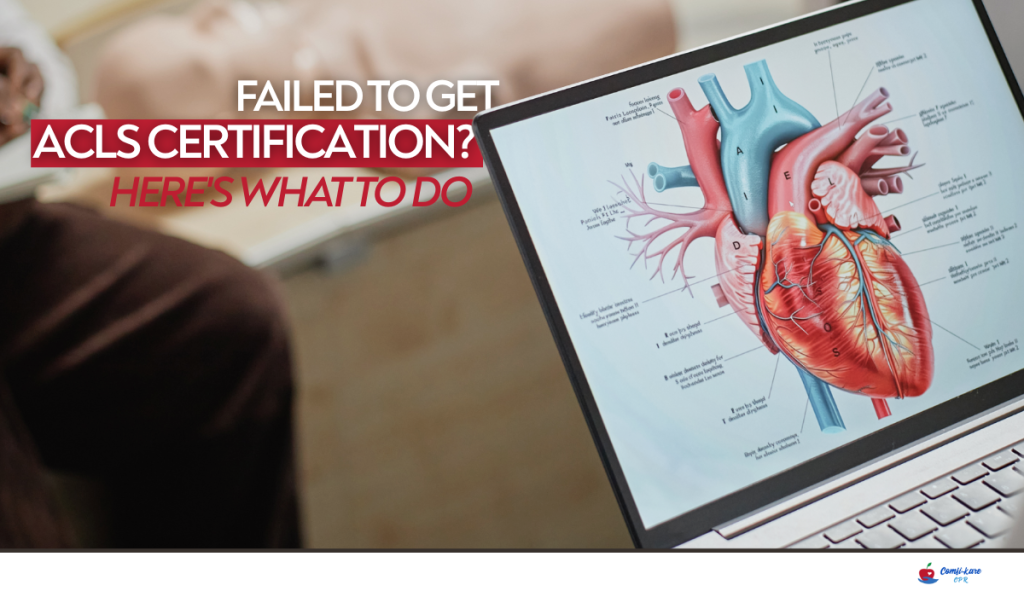
Dealing with Advanced Cardiac Life Support (ACLS) failure can be overwhelming. It strikes fear and downgrades your confidence level as a dedicated healthcare professional. So, if you have been feeling stuck due to your failed ACLS course, buckle up, as we are here.
All you need to do is navigate the setbacks and follow the path to successful advanced cardiac life support certification. This blog will give you guidelines on how you can prepare yourself better for the next ACLS certification. Following the guide will help you focus on your shortcomings and move on the right track.
Key Takeaways
- The ACLS exam is challenging — but with the right preparation, it is completely passable.
- The ACLS certification exam tests knowledge AND performance — prepare for both.
- Always ask your instructor exactly where you lost points.
- The right guidance makes getting your ACLS certification completely achievable.
What is ACLS?
ACLS, or Advanced Cardiac Life Support, is a program specially designed for healthcare professionals or medical students. The course helps them to be more medically trained so that they can recognize and manage life-threatening conditions, like cardiac arrest or respiratory failure.
ACLS certification is designed for:
- Registered Nurses (RNs) and Nurse Practitioners (NPs) — especially those working in ICUs, ERs, or cardiac care units where rapid response is critical
- Emergency Medical Technicians (EMTs) and Paramedics — who are often first on scene during cardiac emergencies
- Physicians, residents, and medical students — required in most hospital settings before independent practice
- Respiratory Therapists and Anesthesiologists — managing airways and ventilation during life-threatening events
- Any healthcare professional seeking career advancement or hospital employment requirements
Understanding Your ACLS Score
What are ACLS scores?
Just like any other course, the ACLS certification course also has a grading system to analyze the performance of the participants. The scores help to give a clear picture of the candidates’s knowledge and skills during a medical emergency.
So, when performed in a simulated scenario, the scoring system used in ACLS helps acknowledge the real performance during a stimulating medical scenario. This helps the ACLS instructor measure their performance, decision-making skills, knowledge of medical emergencies, effective communication, and proper execution.
Components of the ACLS Score
- Knowledge
You cannot perform your CPR skills unless you have a theoretical knowledge of cardiac rhythm. The proper administration of hands-on training skills helps them perform in the right manner. As a result, you need to have thorough knowledge before administering the right technique for CPR.
During the course, candidates strengthen this theoretical foundation through guided study materials, video tutorials on cardiac rhythm interpretation, and practice quizzes that reinforce key concepts before the assessment.
- Skills
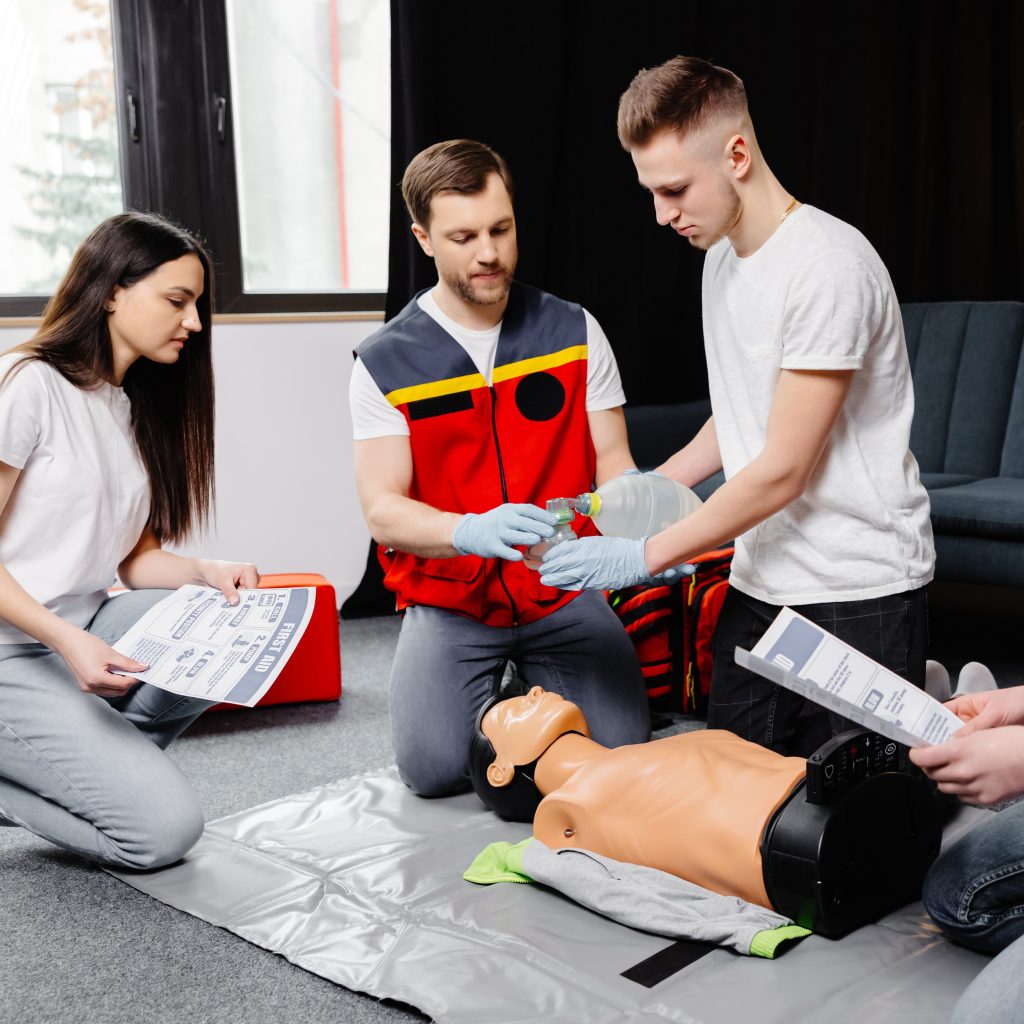
Once you have gained a thorough understanding of ACLS algorithms, it is time to learn the right skills. Therefore, you need to focus on improving skills like high-quality CPR, Automated External Defibrillator (AED), airway management, medication administration, and so on. The ACLS instructor also takes note of your leadership skills and communication. This demonstrates your quick decision-making skills and enhances your leadership qualities.
Throughout the course, candidates develop these skills through hands-on manikin practice, megacode simulation drills, and team-based scenario exercises. At Comfi-kare CPR, our instructors are certified to guide you through all the stages of obtaining your ACLS certification.
Breakdown of the Scores
Based on your performance, your ACLS scores are divided into:
- Written assessment
Your written test gives a comprehensive idea of your theoretical knowledge during a medical emergency. The ACLS exam questions are designed to determine the complexity of the topics and evaluate your complete knowledge of cardiovascular emergencies.
So, the ACLS instructor analyzes:
- Step-by-step protocol to manage cardiac emergencies
- Proper medication dosage and usage
- Recognizing and interpreting cardiac rhythms
- Applying theoretical knowledge in a simulated emergency environment
- Practical Assessment
Your practical knowledge helps the ACLS instructor comprehend whether you can perform effectively in a medical scenario. Based on your theoretical knowledge, the practical skill sets help in evaluating your ability to apply your knowledge in these scenarios.
So, the score is based on:
- Administering chest compression depth and rate
- Appropriate airway management
- Calculating dosage and demonstrating AED skills
- Administering medication
- Effective communication skills
- Leadership and collaboration skills
So, the overall ACLS score depends on your total grade, combining both the written and practical assessments.Keep in mind that failing either assessment means you will need to retake the course — which is why balanced preparation across both theory and practical skills is essential.
Failed Your ACLS Exam? 17 Tips to Pass Your Next One
Failing your ACLS certification does not define your skills as a healthcare professional. It means one thing: you need a smarter approach for next time. Here are 18 real tips — the kind your instructor knows but most articles never tell you.
- Ask your instructor exactly which moment cost you points — not just which section. “You failed the practical” tells you nothing useful. Ask: “At what specific moment did I lose points?” That single answer is worth more than hours of general studying.
- Treat the written exam and the practical as two completely different challenges. Most people who fail study both the same way. They don’t work that way. The written exam tests what you know. The practical tests how you perform under pressure. Each needs its own preparation plan.
- Learn the H’s and T’s by heart — they show up everywhere. The 5 H’s (Hypovolemia, Hypoxia, Hydrogen ion, Hypo/Hyperkalemia, Hypothermia) and 5 T’s (Tension pneumothorax, Tamponade, Toxins, Thrombosis, Trauma) are the reversible causes of cardiac arrest. They appear in the written exam AND in megacode scenarios. If you can’t list all 10 in under 30 seconds, keep practicing.
- Stop memorizing algorithms like a list — understand the logic behind each step. When a scenario goes slightly off-script, memorized steps fall apart. But if you understand why CPR comes before medication, or why you check stability before cardioversion, you will always know what to do next — even in a scenario you’ve never seen before.
- Practice rhythm recognition until it’s instant — not until it’s familiar. VF, pulseless VT, PEA, and asystole need to be recognized in under 3 seconds. Familiar is not the same as instant. If you still need a moment to think, you need more repetitions — not more reading.
- Say every action out loud during practice, every single time. In the megacode, silent actions are invisible actions. Your instructor scores what they can see and hear. Practice narrating out loud: “Checking for pulse — no pulse — starting compressions.” Do it until it feels completely natural, not just when you remember to.
- The most failed moment in the practical is the switch between actions — not the actions themselves. Most candidates fail during transitions — from compressions to rhythm check, from shock delivery back to CPR. These handoffs must be smooth and fast. Practice them specifically, not just the individual skills.
- Never pause CPR for more than 10 seconds — for any reason. Not for intubation. Not for a rhythm check. Not for medication. The 10-second rule is strict and actively scored. If your transitions are taking longer, that is what you practice first.
- Knowing when NOT to use the defibrillator is just as important as knowing when to use it. PEA and asystole are non-shockable rhythms. Reaching for the defibrillator when you see a flat line is an automatic failure in the practical. Rhythm identification must always happen before any intervention.
- Closed-loop communication is actively scored — most candidates don’t practice it enough. Every order you give must be confirmed back to you. “Give 1mg epinephrine.” — “1mg epinephrine given.” This sounds simple but breaks down completely under pressure without deliberate practice. Do it out loud every time during your preparation.
- Physical fatigue during compressions causes more failures than people expect. After 90 seconds of real compressions, most people’s depth and rate start to drop noticeably. If you are practicing on a manikin, push through the full 2-minute cycle every time. Your body needs to know what it feels like to maintain quality compressions when you are tired.
- Don’t skip the post-ROSC protocol — most candidates underprepare this part. What happens after the patient gets a pulse back is tested and frequently missed. After return of spontaneous circulation (ROSC), you need to manage oxygen levels carefully, avoid hyperventilation, and monitor blood pressure. Many candidates have the arrest algorithm perfect but fall apart the moment the “patient” recovers.
- Anxiety is a performance problem, not a knowledge problem — treat it that way. If you froze or blanked during the practical, more studying won’t fix it. More exposure will. Run as many live scenario drills as possible before retaking, ideally with colleagues watching. The discomfort you feel in practice is exactly what builds calm during the real test.
- Don’t wait more than 30 days to retake the exam. The material fades faster than you think. Your instructor’s feedback is most useful right now while everything is still fresh in your memory. The longer you wait, the more you’ll have to relearn from scratch.
- Watch out for qualifier words in the written exam — they change the correct answer completely. Words like “first,” “next,” “most appropriate,” and “immediately” are not decoration. They are the question. Two answer choices can both be clinically correct, but only one is correct at that moment in the scenario. Read every question twice before answering.
- Teach what you’re struggling with to someone else — even out loud to yourself. Explaining a concept forces you to find the gaps in your own understanding. If you can’t explain the tachycardia algorithm simply and clearly to someone who doesn’t know it, you don’t know it well enough yet either.
- Go into the retake knowing the exam is designed for you to pass — not to trick you. ACLS exists to make sure healthcare professionals can save lives, not to create barriers. The scenarios are fair, the algorithms are logical, and the instructors want you to succeed. Confidence built on solid preparation is your most powerful tool walking back in.
Conclusion
Failing your ACLS certification exam is not the end — it is the beginning of a stronger, more prepared version of you as a healthcare professional. Every tip in this guide exists for one reason: to make sure that when you walk back into that room, you are ready in every way that counts.
The path to getting your ACLS certification is not about being perfect. It is about understanding the material deeply, performing consistently under pressure, and knowing exactly where you fell short last time so you don’t repeat it.
If you are in Maryland and ready to retake your ACLS certification exam with the support of experienced, certified instructors, Comfikare CPR is here to help. Contact us today and let’s get you certified.
Frequently Asked Questions
What happens if I fail ACLS?
Failing your ACLS certification exam does not mean your career is over or that you are a bad healthcare professional. It means you need more focused preparation in specific areas. You can retake the exam — most training centers allow you to do so without additional fees. Ask your instructor for a detailed score breakdown, identify exactly where you lost points, and come back stronger.
Is it hard to get ACLS certified?
It depends on your preparation. Many candidates search for ACLS exam questions and practice tests before their course — and that is exactly the right instinct. With solid study habits, hands-on practice, and a good understanding of the core algorithms, most healthcare professionals pass. The material is demanding because lives depend on it — but the ACLS exam is designed to be passed, not to trick you.
Is ACLS a certificate or certification?
ACLS is a certification. A certificate simply proves you completed a course. An ACLS certification proves you demonstrated the knowledge and skills required to manage life-threatening cardiac emergencies — and it must be renewed every two years to stay valid.
Is ACLS harder than BLS?
Yes. BLS covers the fundamentals — CPR, AED use, and rescue breathing. ACLS builds on top of BLS and adds cardiac rhythm recognition, advanced airway management, emergency pharmacology, and team leadership during complex resuscitation scenarios. If your BLS foundation is weak, the ACLS exam will feel significantly harder.
Are ACLS necessary?
For most healthcare professionals working in emergency, critical care, or hospital settings, ACLS certification is not optional — it is a job requirement. Beyond employment, it is simply the standard of care. Knowing how to respond in a cardiac emergency is a professional responsibility, not just a box to check.
How many questions are on the ACLS test?
The ACLS exam consists of 50 multiple choice questions. Reviewing ACLS exam questions and understanding why each answer is correct — not just memorizing ACLS exam answers — is the most effective way to prepare. You need to score at least 84% to pass, which means you can miss no more than 8 questions. The exam covers cardiac rhythms, algorithms, pharmacology, and emergency decision-making.